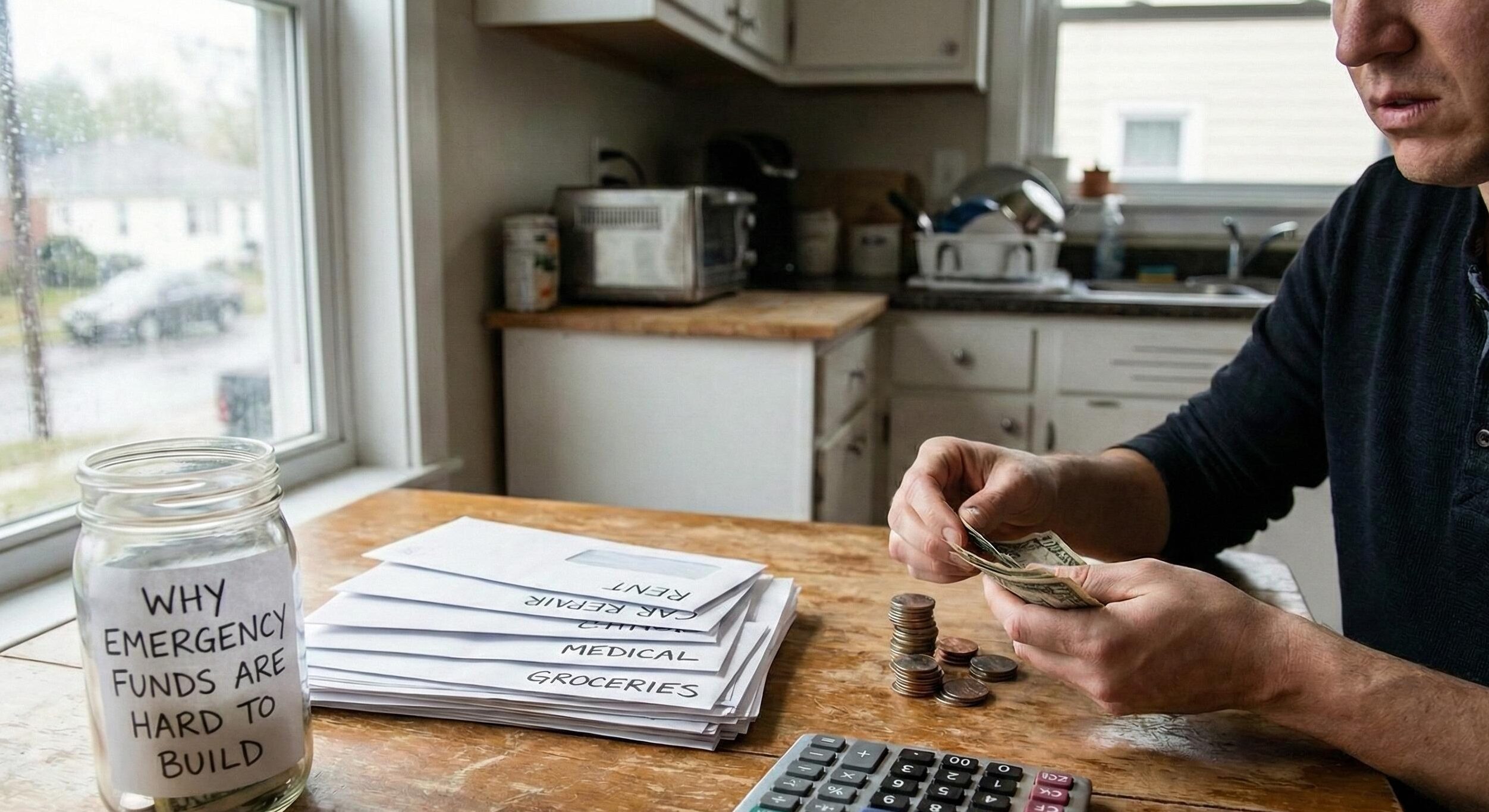
You know you need one. Financial experts won’t stop talking about it. Yet every time you try to set money aside for emergencies, life seems to have other plans.
Building an emergency fund shouldn’t feel this hard—but for most people, it does.
The Gap Between Knowing and Doing
Everyone understands the concept of an emergency fund. It’s simple: save three to six months’ worth of expenses in case something unexpected happens. Job loss, medical bills, car breakdowns—these aren’t hypothetical scenarios. They’re real events that happen to real people every single day.
Yet despite this knowledge, most households don’t have adequate emergency savings. The gap between understanding the need and actually building the fund reveals something important about how money works in our daily lives.
This isn’t about laziness or poor planning. The difficulty runs much deeper than that.
Why Emergency Funds Feel Like an Uphill Battle
The challenge begins with how we experience money. Every dollar that comes into your life already has a job waiting for it. Rent or mortgage payments arrive with predictable regularity. Utility bills don’t negotiate. Groceries aren’t optional. Transportation to work costs money whether you drive or take public transit.
Beyond these necessities, there are debts. Student loans, credit cards, car payments—these obligations demand attention every month. The minimum payments alone can consume a significant portion of your income.
Then come the less obvious but equally real expenses. Your child needs new shoes because they’ve outgrown the old ones. The prescription medication isn’t covered by insurance. Your aging parent needs help with their medical costs. These aren’t luxuries. They’re responsibilities that carry emotional weight alongside financial pressure.
By the time you’ve addressed these immediate needs, the money left over feels precious. Using it for something you might need in the future—rather than something you definitely need today—requires a level of financial security many people simply don’t have.
The psychological aspect compounds the practical challenge. Setting aside money for a vague future emergency lacks the emotional satisfaction of addressing a present need. When you pay your electricity bill, the lights stay on. When you buy groceries, your family eats. When you put money into an emergency fund, nothing visible changes.
This absence of immediate reward makes the behavior harder to sustain. Our brains are wired to prioritize present needs over future possibilities. The emergency fund asks you to do the opposite.
The Income Reality Most People Face
Income stability plays a crucial role in emergency fund building, yet many discussions about saving assume a level of financial predictability that doesn’t match reality for a large portion of workers.
Traditional advice about emergency funds was developed during an era when stable, long-term employment with a single employer was common. You worked for a company, received regular raises, and could reasonably predict your income months or years in advance.
Today’s employment landscape looks different. Gig economy work, contract positions, seasonal fluctuations, and commission-based income create variability that makes consistent saving genuinely difficult. When you don’t know exactly how much you’ll earn next month, deciding how much to save this month becomes complicated.
Even people with traditional full-time jobs face income uncertainty. Overtime hours get cut. Bonuses don’t materialize. Department restructuring leads to position elimination. The apparent stability of a regular paycheck can disappear faster than most people anticipate.
This income variability creates a specific problem for emergency fund building. You need the emergency fund most when your income is unstable, but unstable income makes building the fund exceptionally difficult.
What Most People Misunderstand About Emergency Funds
The standard advice suggests you need three to six months of expenses saved before your emergency fund is complete. This benchmark, while well-intentioned, creates problems for people trying to build savings from zero.
The goal feels so distant that it becomes paralyzing. If you need fifteen thousand dollars and you have zero dollars saved, the gap seems impossible to bridge. The enormity of the target can actually prevent people from starting at all.
This is one of the biggest misunderstandings about emergency funds: the idea that they’re either complete or useless. In reality, any amount of savings provides more security than no savings at all.
Having five hundred dollars saved won’t cover a job loss, but it will cover many car repairs. A thousand dollars won’t replace three months of income, but it will handle most urgent medical expenses not covered by insurance. Two thousand dollars creates breathing room when unexpected expenses arise.
The other major misunderstanding involves the word “emergency” itself. People often feel they need to determine in advance what qualifies as an emergency worthy of using these funds. This creates anxiety and decision paralysis when unexpected expenses occur.
The truth is simpler: an emergency fund exists to prevent small financial disruptions from becoming large financial crises. Whether something technically qualifies as an emergency matters less than whether using these savings prevents you from taking on debt or missing other important payments.
The Competing Priorities Problem
Another layer of difficulty comes from conflicting financial advice. You’re told to build an emergency fund. You’re also told to pay off high-interest debt. And to save for retirement. And to invest for your children’s education. And to save for a house down payment.
All of this advice is technically sound. Each goal has merit. But when you’re working with limited resources, you can’t pursue every worthy financial goal simultaneously. You have to choose.
This is where the emergency fund often loses out. Paying off a credit card with twenty percent interest saves you real money every month. Contributing to a retirement account might come with an employer match—literally free money you’ll lose if you don’t contribute. These competing priorities have immediate, calculable benefits.
The emergency fund, by contrast, has a future and uncertain benefit. You might need it. You might not. This uncertainty makes it easy to deprioritize, especially when other financial goals offer more concrete returns.
Maya, a teacher in her early thirties, experienced this conflict directly. She had student loans at seven percent interest, a credit card balance at eighteen percent, and her employer offered a four percent retirement match. Every financial calculator she consulted gave different advice about which goal to prioritize. She spent months feeling paralyzed by analysis, making minimal progress on any goal because she couldn’t decide which deserved focus. The emergency fund, being the least urgent and most abstract, kept getting pushed to “next month.”
Why Small Setbacks Feel Large
Progress on emergency fund building rarely follows a straight line. You save two hundred dollars one month, then spend it the next when your dog needs unexpected veterinary care. You build up five hundred dollars, then your car needs new brakes. You reach a thousand dollars, then your child’s school requires fees for a mandatory field trip.
Each of these setbacks is normal. They’re the exact reason emergency savings exist. Yet psychologically, they feel like failure.
When you’re trying to build savings and keep depleting the account for unexpected expenses, it creates a frustrating sense of running in place. The balance never seems to grow. The goal never gets closer.
This emotional toll matters because it affects behavior. After enough setbacks, some people stop trying to save altogether. If the money’s just going to get spent on emergencies anyway, why bother putting it aside?
This thinking misses an important point: those emergencies would have happened regardless. Without the emergency savings, each unexpected expense would have gone on a credit card, creating debt with interest charges that compound over time. The emergency fund prevented that debt even though the balance returned to zero.
The Timing Problem Nobody Talks About
Emergency funds face a unique timing challenge. You need the fund most desperately during the exact periods when building it is hardest.
When employment is stable and income is secure, saving feels more manageable. But these are also the times when an emergency fund feels less urgent. The bills are getting paid. Nothing seems imminently threatening. It’s easy to let savings slide.
When employment becomes unstable or unexpected expenses start piling up, the need for an emergency fund becomes painfully obvious. But these are precisely the times when directing money toward savings feels impossible. Every dollar is already spoken for.
This inverse relationship between need and ability creates a perpetual challenge. You’re trying to build a safety net while standing on stable ground so it’s ready when the ground becomes unstable. But our psychology and circumstances often work against this kind of forward planning.
What Actually Works: A More Realistic Framework
Understanding why emergency funds feel difficult doesn’t make them easier to build, but it does suggest more realistic approaches than traditional advice offers.
Starting with a smaller, more achievable initial goal changes the psychology of saving. Instead of aiming for three months of expenses—a number that might be ten or fifteen thousand dollars—aim for one month of the most essential expenses only. Not the full cost of maintaining your current lifestyle, just the absolute necessities: housing, minimum food budget, utilities, insurance.
This number is still substantial, but it’s more approachable. For many people, it might be three to five thousand dollars rather than fifteen thousand. The goal feels possible rather than overwhelming.
Even better, start with an initial target of just one thousand dollars. This amount won’t cover every possible emergency, but it covers many common ones. It provides a foundation you can build on. And crucially, it’s achievable within a reasonable timeframe for most people who can direct even small amounts toward saving.
The path to one thousand dollars becomes clearer when broken into smaller increments. Two hundred fifty dollars saved four times. One hundred dollars saved ten times. Fifty dollars saved twenty times. The specific path matters less than the fact that progress becomes visible.
Visibility of progress matters more than most financial advice acknowledges. When you can see the balance growing, even slowly, it reinforces the behavior. Each deposit proves that building savings is possible for you, not just for people in different financial circumstances.
The Flexibility Factor
Rigid rules about emergency funds often backfire. Being told you cannot touch the money except for specific types of emergencies creates anxiety and can prevent people from using the fund when they genuinely need it.
A more sustainable approach treats the emergency fund as a tool for financial stability rather than a sacred account with strict withdrawal rules. If using five hundred dollars from your emergency fund prevents you from putting a car repair on a credit card at twenty percent interest, that’s a good use of the fund. Yes, you’ll need to rebuild that portion of savings. But you avoided debt and the compound interest that comes with it.
The key distinction is between using emergency funds to prevent financial problems and using them to maintain spending patterns. Using the fund to avoid debt when unexpected expenses arise makes sense. Dipping into it regularly for routine expenses that should be budgeted normally doesn’t.
This flexibility extends to how you build the fund as well. Traditional advice often suggests setting up automatic transfers that move a fixed amount into savings each month. This works well for people with stable, predictable income. For everyone else, it can create problems.
If your income varies month to month, rigid automatic transfers might pull money you need for essential expenses. A more flexible approach transfers whatever amount you can afford each month, even if that amount changes. Some months might be fifty dollars. Others might be zero. Occasionally, you might manage two hundred dollars.
The irregularity feels less disciplined than automatic saving, but it’s more sustainable when income isn’t regular. Sustainability matters more than perfection when building long-term financial habits.
The Debt and Savings Balance
The question of whether to focus on debt repayment or emergency fund building simultaneously confuses many people. Personal finance experts offer conflicting advice because both priorities have merit.
High-interest debt costs real money every month it remains unpaid. A credit card balance at twenty percent interest growing due to compound interest is genuinely urgent. Paying it off saves you money and frees up monthly cash flow.
Yet having zero emergency savings creates vulnerability. Without any financial cushion, the next unexpected expense goes on that credit card you’re trying to pay off, undoing your progress.
A middle path often works better than choosing one goal exclusively. Build a small emergency fund first—perhaps five hundred to one thousand dollars—while making minimum payments on debt. This small cushion prevents minor emergencies from derailing debt payoff progress.
Once that small emergency fund exists, shift focus more heavily toward high-interest debt while continuing to add smaller amounts to savings. After the most expensive debt is eliminated, return focus to building the emergency fund to a fuller amount.
This approach isn’t mathematically optimal. Paying off high-interest debt first and only then building savings would save more money on interest charges. But financial decisions aren’t purely mathematical. They’re psychological and practical as well. Having some emergency savings provides peace of mind and prevents small setbacks from becoming large ones.
The Income Side of the Equation
Most advice about building emergency funds focuses exclusively on the spending side: reduce expenses, cut unnecessary costs, find money in your current budget to redirect toward savings. This advice assumes the problem is wasteful spending rather than insufficient income.
For many people, the limiting factor isn’t spending—it’s earning. When income barely covers essential expenses, there’s nothing to cut. No amount of budgeting creates money that doesn’t exist.
This reality doesn’t appear often enough in mainstream financial advice, which tends to assume everyone has discretionary spending that could be eliminated. Many households don’t. They’re already operating efficiently on a tight budget.
When expenses are already minimal and there’s still nothing left to save, the problem requires an income solution, not a spending solution. This might mean negotiating a raise, seeking higher-paying employment, developing additional skills that command more compensation, or finding ways to generate supplementary income.
These solutions are neither quick nor easy. They require time, energy, and often some financial investment in skill development. But acknowledging that insufficient income is the real barrier—rather than assuming the problem is always spending—matters for both practical and psychological reasons.
People who are genuinely doing their best with limited resources don’t need to be told to try harder or spend less. They need acknowledgment that their situation is difficult and that building emergency savings might require changes beyond their immediate control.
The Role of Unexpected Windfalls
Tax refunds, work bonuses, monetary gifts, insurance reimbursements, and other irregular income create opportunities for accelerating emergency fund building. Yet many people spend these windfalls entirely on current wants or needs without directing any portion toward savings.
This happens for understandable reasons. When you’ve been operating with limited resources and suddenly receive extra money, the temptation to address all the things you’ve been putting off becomes strong. The car needs new tires. You’ve been wearing the same worn-out shoes for months. The kids need things you’ve been saying no to.
A balanced approach splits unexpected money between immediate needs and future security. If you receive a thousand-dollar tax refund, putting five hundred toward current needs and five hundred toward emergency savings serves both present and future you.
This split ratio isn’t a rule. It’s a framework for thinking about irregular income as an opportunity to make progress on multiple goals rather than spending it entirely on one purpose.
Why the Target Keeps Moving
One frustrating aspect of emergency fund building is that the target changes as your life circumstances change. When your rent increases, your emergency fund needs to grow to cover the new, higher monthly expenses. When you have a child, your required emergency fund grows. When you take on a car payment, the target shifts upward.
This moving target can feel discouraging. You work toward a goal, finally reach it, then realize the goal has moved further away.
This is normal. Emergency funds scale with your life and financial obligations. The alternative—keeping the same emergency fund target as your expenses grow—would mean the fund becomes less adequate over time.
Understanding this helps set appropriate expectations. You’re not building an emergency fund once and then being done forever. You’re creating a financial buffer that needs periodic evaluation and adjustment as your circumstances change.
What Three Months Really Means
The standard emergency fund target of three to six months of expenses deserves closer examination. These numbers didn’t appear arbitrarily. They’re based on average unemployment duration and the time it typically takes to find new employment after job loss.
But averages don’t reflect everyone’s reality. Some industries have longer hiring timelines. Some locations have fewer employment opportunities. Some specializations take longer to match with appropriate positions.
Additionally, the three-to-six-month guideline assumes your expenses during unemployment would match your current expenses. In reality, some expenses would decrease during unemployment—perhaps commuting costs or work clothing—while others might increase, such as health insurance if you lose employer coverage.
The point isn’t that three to six months is wrong. It’s that treating it as a universal requirement misses individual variation. Someone in a specialized field in a small job market might need a larger fund than someone with easily transferable skills in a city with many employers.
Rather than strictly following a guideline that might not fit your circumstances, consider what amount would let you sleep better at night. For some people, that’s two months of expenses. For others, it’s eight months. The peace of mind matters more than adherence to conventional wisdom.
The Plateau Effect
Many people experience a pattern when building emergency savings: initial progress, then a long plateau where the balance stops growing. This happens even when they’re still adding money regularly.
The plateau occurs because as the emergency fund grows, it becomes a tempting source of money when unexpected expenses arise. When you had two hundred dollars saved and your car needed a four hundred dollar repair, you had no choice but to use a credit card or find another solution. When you have two thousand dollars saved and the same repair occurs, using the emergency fund feels reasonable.
Both decisions make sense. The emergency fund is working as intended by covering unexpected expenses. But psychologically, the static balance feels like lack of progress.
This is where tracking becomes helpful. Instead of only looking at current balance, track total deposits over time. If you’ve deposited five thousand dollars into emergency savings over two years, even if the current balance is only two thousand dollars, you’ve successfully used the fund to handle three thousand dollars of unexpected expenses without going into debt.
That’s progress, even though the balance doesn’t show it.
The Long View
Emergency funds are fundamentally about time—buying yourself time when circumstances change suddenly. Time to find new employment without immediately facing eviction. Time to recover from illness without missing essential payments. Time to handle unexpected expenses without creating debt that will cost you more later.
This time buffer doesn’t eliminate financial stress, but it transforms sudden crises into manageable problems. The difference between having no savings when you lose your job and having even one month of expenses saved is profound. It’s the difference between immediate desperation and having a few weeks to figure out your next steps.
Building this buffer happens slowly for most people. Not because they’re doing something wrong, but because turning limited resources into future security while meeting current needs is genuinely difficult work.
Progress might be irregular. You might experience setbacks. The target might seem impossibly distant for months or years. But each small deposit moves you incrementally toward greater stability. Each time you use the fund to avoid debt, you’re benefiting from past effort. Each month you maintain even a small balance, you have more security than you would without it.
The difficulty is real. The challenge is legitimate. And the progress, however slow, is worthwhile. You’re not failing at something that should be easy. You’re succeeding at something that is genuinely hard. FOLLOW FOR MORE…