
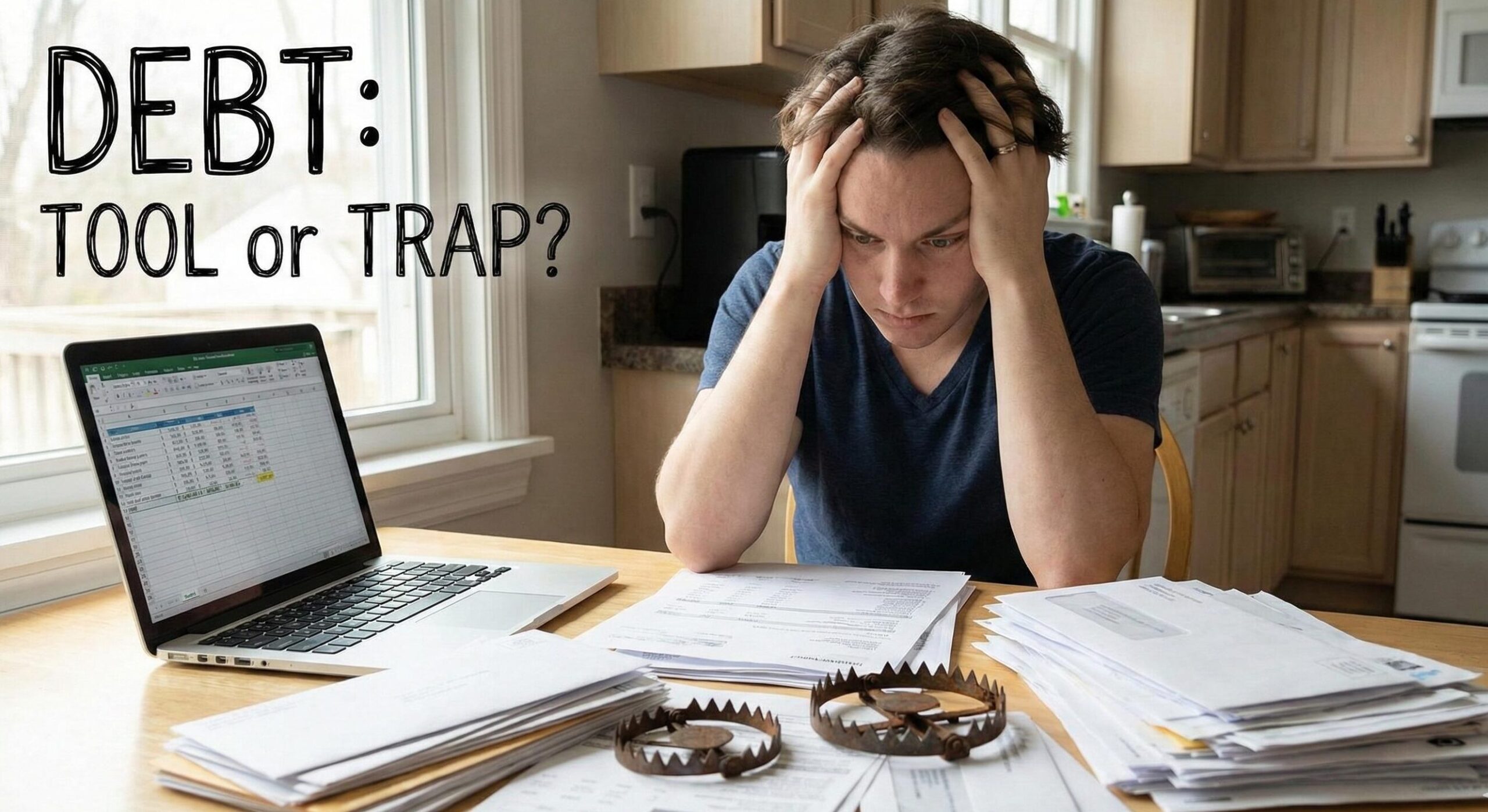
You took the loan for a good reason. Education, a vehicle for work, a medical emergency, maybe a business opportunity. It made sense at the time, and the monthly payment seemed manageable. But somewhere along the way, something shifted. Now you’re paying interest on interest, juggling minimum payments, and the debt that was supposed to help you move forward feels like it’s pulling you backward. That moment—when debt stops being a tool and starts becoming a trap—doesn’t announce itself. It happens quietly, and by the time you notice, you’re already stuck.
Why Debt Exists in Two Different Forms
Debt isn’t inherently good or bad. It’s a financial instrument, neutral in itself. What determines whether debt functions as a tool or becomes a trap is how it’s used, what it costs, and whether you can realistically pay it back while maintaining financial stability.
As a tool, debt lets you access opportunities you couldn’t afford otherwise. Education that increases your earning potential. A reliable vehicle that gets you to work. A home instead of decades of rent. Equipment for a business. Medical treatment you need now. These uses of debt can genuinely improve your life if the math works—if what you gain from the debt exceeds what you pay for it over time.
As a trap, debt does the opposite. It extracts money from your future to patch holes in your present, without creating anything of lasting value. It shrinks your financial options instead of expanding them. It demands more and more of your income until you’re working primarily to service debt, not to build a life.
The same loan can be either, depending on the circumstances. A personal loan for a certification that doubles your income is a tool. The same loan to cover regular expenses because your spending exceeds your income is a trap. The difference isn’t the debt itself—it’s the context and trajectory.
The Turning Point Most People Miss
There’s a specific moment when debt stops being a tool and starts becoming a trap, and most people don’t recognize it until they’re well past it. It’s not when you take the loan. It’s when your debt service—the total amount you pay toward all debts each month—starts constraining your other financial choices.
Here’s what that looks like in practice. Initially, your loan payments fit comfortably within your budget. You’re paying them on time, meeting other obligations, maybe even saving a little. The debt is serving its purpose, and you’re managing it fine.
Then something changes. Maybe your income stays flat while expenses rise. Maybe you take on additional debt. Maybe interest rates adjust upward. Maybe an unexpected expense forces you to choose between debt payments and necessities. Suddenly, the debt payments aren’t just another line item in your budget—they’re dictating what you can and can’t do with the rest of your money.
That’s the turning point. When debt service goes from being something you manage to something that manages you, the transformation from tool to trap is underway. And most people don’t notice because it happens gradually, one compromised decision at a time.
The Psychology of Justification
One reason debt transitions from tool to trap so easily is that we’re exceptionally good at justifying our borrowing decisions. Every loan feels necessary at the moment you take it. Your brain is wired to rationalize choices you’ve already made, and debt is no exception.
You needed the emergency fund loan because you didn’t have savings. You needed the credit card for that expense because cash flow was tight that month. You needed the personal loan because an opportunity came up. Each individual decision has logic behind it. But logic in isolation doesn’t account for accumulated burden.
This is how people end up with multiple loans, each individually justified, collectively unsustainable. No single debt feels like the problem. But together, they create a structure where an increasing percentage of income goes toward servicing past decisions instead of funding current life or future opportunities.
The psychological trap is that justification feels like wisdom. You’re being responsible by meeting your obligations. You’re being practical by using available credit. You’re being opportunistic by leveraging debt for growth. All of that can be true and still lead to debt becoming a trap if the total burden exceeds your capacity to carry it sustainably.
When Good Debt Goes Bad
Even debt taken for legitimate, value-creating purposes can transform into a trap under the wrong circumstances. This is what most people misunderstand—they think as long as the original purpose was sound, the debt remains sound. That’s not how it works.
Student loans are the clearest example. Education debt is widely considered “good debt” because education theoretically increases earning potential. But when the debt burden is disproportionate to actual post-education income, when the field you studied doesn’t lead to the career you expected, when the economy shifts and jobs disappear, that education debt doesn’t care about the theory. It still demands payment.
The same applies to business loans, vehicle loans, even mortgages. The purpose might have been legitimate, but if circumstances change—if the business struggles, if you lose the job that required the vehicle, if property values crash or interest rates spike—the debt doesn’t adjust to your new reality. It keeps demanding what you agreed to pay.
This is when debt stops being a tool and starts becoming a trap even for people who borrowed responsibly for the right reasons. The trap isn’t always the result of poor decisions. Sometimes it’s the result of circumstances beyond your control colliding with fixed obligations.
The Minimum Payment Illusion
Credit cards and revolving debt introduce a specific mechanism that accelerates the transformation from tool to trap: the minimum payment. It’s designed to feel manageable while actually maximizing the time you stay in debt and the total interest you pay.
Paying only the minimum feels like you’re meeting your obligation. Technically, you are. But practically, you’re ensuring that the debt will take years or decades to clear, and that you’ll pay multiples of what you originally borrowed in interest charges.
Here’s the insidious part: minimum payments create the illusion of control. You’re not defaulting. Your credit score might even be fine. But you’re trapped in a cycle where the debt isn’t actually decreasing in any meaningful way, where new interest accrues as fast as or faster than your payments reduce the principal.
This is one of the clearest markers of debt as trap rather than tool. If your payments aren’t meaningfully reducing what you owe, if the timeline to being debt-free keeps extending, if you can’t see a realistic end point, the debt has stopped serving you and started consuming you.
The Debt Cascade Effect
Debt rarely stays isolated. One loan often leads to another, not through recklessness, but through mathematical necessity. This cascade effect is how manageable debt becomes unmanageable debt, and it’s remarkably common among middle-class borrowers.
It starts simply enough. You have one loan with a predictable payment. Then something happens—a medical expense, a wedding, a car repair. You don’t have the cash because your margin is thin after covering the existing loan payment. So you borrow again. Now you have two payments.
The second loan reduces your margin further. When the next unexpected expense arrives, you have even less capacity to handle it without borrowing. Third loan, fourth loan. Each one individually justifiable, collectively crushing.
A friend of mine went through exactly this. She took an education loan that was perfectly affordable on her projected starting salary. Then she needed a laptop for work—small loan, seemed fine. Then her roommate moved out and rent doubled until she found a replacement—credit card debt. Then her scooter broke down and she needed it for her commute—another small loan. Within two years, she was paying forty percent of her income toward debt service across four different obligations. None of them individually unreasonable, together completely unsustainable.
This cascade is how debt stops being a tool and starts becoming a trap for people who never intended to overborrow. It’s not one big mistake—it’s a series of small, justifiable decisions that compound into an overwhelming burden.
The Income-to-Debt Ratio Reality
There’s a threshold, different for everyone but universal in concept, where debt service consumes enough of your income that financial stability becomes impossible. Financial advisors often cite numbers—don’t let debt payments exceed thirty or forty percent of income—but the real limit is more personal.
When your debt payments leave you unable to save anything, you’re approaching trap territory. When they force you to choose between necessities, you’ve crossed into it. When an unexpected expense of even a few thousand rupees would require more borrowing, you’re firmly stuck.
The trap isn’t just about the percentage. It’s about flexibility. Debt as a tool leaves you with choices. Debt as a trap eliminates them. If you can’t handle a moderate disruption without taking on more debt, if you can’t reduce spending in one area to increase it in another because debt payments are fixed and consume most of your margin, you’re trapped.
This is true regardless of income level. Someone earning a lakh a month can be trapped by debt just as completely as someone earning thirty thousand, if their obligations exceed their capacity to manage them while maintaining any financial buffer.
The Interest Rate Accelerator
Not all debt is created equal, and interest rates are where that inequality becomes most apparent. Low-interest debt can remain a tool almost indefinitely if managed well. High-interest debt becomes a trap almost immediately.
The math is brutal. On high-interest debt, a significant portion of every payment goes to interest rather than principal. This means you’re running hard just to stay in place. The outstanding amount decreases slowly, while the total cost of the debt—principal plus all interest paid—can end up being double or triple what you originally borrowed.
High-interest debt creates a situation where debt stops being a tool and starts becoming a trap purely through the cost structure. Even if you’re making payments diligently, even if the original purpose was legitimate, the interest burden can transform manageable debt into a years-long financial drain.
This is particularly true for credit card debt and personal loans with high rates. What seems like a small convenience—borrowing for a few months to smooth out cash flow—becomes a multi-year obligation if you can’t pay it off quickly, purely because of how interest compounds.
When Borrowing to Pay Debt Begins
One of the clearest signs that debt has become a trap is when you start borrowing to pay existing debt. This includes using one credit card to pay another, taking personal loans to clear credit cards, or any form of debt shuffling.
Sometimes this is framed as “debt consolidation” and can be a legitimate strategy if it reduces your overall interest burden and creates a clear path to being debt-free. But often, it’s just moving debt around, and worse, it can create the dangerous illusion that you’ve solved the problem when you’ve only reorganized it.
Borrowing to service existing debt means your income alone isn’t sufficient to cover your obligations. That’s the definition of unsustainable. It means you’re deepening the hole while standing in it, and unless something fundamental changes—significant income increase or dramatic expense reduction—the trajectory leads to eventual default or financial crisis.
This is when debt stops being a tool and starts becoming a trap in the most literal sense. The debt itself generates the need for more debt, creating a cycle that’s increasingly difficult to break.
The Emotional Weight of Being Trapped
Beyond the mathematics, debt as trap carries psychological costs that debt as tool typically doesn’t. There’s a qualitative difference between owing money on a loan that’s serving a clear purpose and owing money that just… exists as a burden.
Trapped debt creates constant background stress. It’s there when you check your account balance, when unexpected expenses arise, when you think about changing jobs or taking time off or making any major life decision. It constrains choices in ways that aren’t always visible until you try to make one.
This emotional weight compounds the financial problem. Stress impairs decision-making. Anxiety about debt can lead to avoidance, where you stop looking at statements or thinking about the problem, which only makes it worse. The shame and frustration can prevent you from seeking help or having honest conversations about the situation.
The psychological trap is as real as the financial one. And it’s often harder to address because money carries so much meaning beyond the purely practical—it’s tied to self-worth, to identity, to how you perceive your competence and your future.
The Path of Least Resistance Versus the Path Forward
When debt becomes a trap, there’s usually a gap between what you’re doing and what would actually help. You make minimum payments because that’s what you can afford, even though it means the debt persists indefinitely. You avoid looking at the total picture because it’s overwhelming. You keep borrowing for emergencies because you don’t have alternatives.
These aren’t character flaws. They’re rational responses to difficult circumstances. But they’re also the path of least resistance, not the path forward. The path forward usually requires confronting uncomfortable realities, making difficult trade-offs, and maintaining focus on a long-term goal when short-term pressures are intense.
This might mean accepting that your lifestyle has to contract temporarily to free up money for debt reduction. It might mean having hard conversations with family about financial constraints. It might mean taking on additional work, selling things, or restructuring your life around the singular goal of eliminating the debt.
None of this is easy, and none of it should be minimized. But the alternative—continuing the same patterns that created the trap—doesn’t lead anywhere better. It just extends the timeline of being trapped.
Understanding the Difference Between Strategic and Survival Debt
There’s an important distinction that often gets lost in conversations about debt: the difference between strategic debt and survival debt. Strategic debt funds growth or opportunity—education, business investment, assets that appreciate or generate income. Survival debt covers gaps between income and expenses—groceries on credit cards, medical emergencies, bills you can’t pay from current income.
Strategic debt can remain a tool if managed well. Survival debt almost always becomes a trap because it’s addressing a fundamental imbalance between your financial inputs and outputs. You can’t borrow your way out of that imbalance. The debt might provide temporary relief, but it worsens the long-term problem by adding debt service to expenses that already exceed income.
When debt stops being a tool and starts becoming a trap is often the moment it shifts from strategic to survival. When you’re no longer borrowing to build something or access an opportunity, but just to keep your head above water, the nature of the debt has fundamentally changed.
The Reality of Default and Consequences
Sometimes, despite best efforts, debt becomes unsustainable. Default isn’t a moral failure—it’s a mathematical outcome when obligations exceed capacity. But it does have real consequences that are worth understanding, not to create fear, but to have realistic expectations.
Default damages credit scores, which affects your ability to borrow in the future and can impact job prospects, housing options, and more. Lenders may pursue legal remedies depending on the type of debt. The stress intensifies. These aren’t abstract consequences—they’re real disruptions to life.
At the same time, default isn’t financial death. Credit can be rebuilt. Life continues. For some people in truly unsustainable situations, default or formal debt resolution processes might be the only realistic path forward. That’s not an endorsement or encouragement—it’s just acknowledging reality.
The point is that when debt becomes a trap, there are choices, and none of them are perfect. Continuing to struggle with unmanageable debt has costs. Defaulting has costs. Dramatically restructuring your life to pay it off has costs. The question becomes which costs you’re willing and able to bear.
What Actually Changes the Trajectory
Recognizing when debt stops being a tool and starts becoming a trap is important, but recognition alone doesn’t change anything. What changes trajectories is action, and specifically, action that addresses the root cause rather than just the symptoms.
If the root cause is overspending relative to income, the action required is either increasing income or decreasing spending to create margin that can be directed toward debt reduction. If the root cause is high interest rates, the action might be refinancing or restructuring to reduce the cost of the debt. If the root cause is too many separate obligations, consolidation might help if it actually simplifies and reduces total cost.
If the root cause is unpredictable income or expenses, the action might be building even a small buffer before aggressively paying down debt, so that new emergencies don’t immediately create new debt. If the root cause is lack of awareness about where money goes, the action is tracking and understanding spending patterns.
None of these actions is easy, and all of them require sustained effort over time. But they’re the actions that actually change whether debt functions as tool or trap. Everything else—worrying, feeling guilty, making minimum payments indefinitely—is just maintenance of the status quo.
Moving From Trap to Tool, or From Debt to Freedom
The ultimate goal when debt has become a trap isn’t necessarily to make it a tool again—sometimes the goal is just to eliminate it and start over. Not all debt needs to be preserved or transformed. Some debt just needs to end.
This requires a shift in thinking from managing debt to eliminating it. Managing debt means keeping up with payments, maintaining the status quo. Eliminating debt means putting every possible rupee toward principal reduction, even when it’s uncomfortable, until the debt is gone.
For some people, this looks like the debt avalanche method—targeting highest interest debt first to minimize total cost. For others, it’s the snowball method—paying off smallest debts first for psychological wins. For others still, it’s negotiating with lenders, seeking hardship programs, or exploring formal debt relief.
The method matters less than the commitment and the realism. You have to see the debt clearly—how much, at what rates, with what terms. You have to see your income and expenses clearly. And you have to make a realistic plan that accounts for your actual life, not an idealized version of it.
The Long View on Debt and Freedom
Understanding when debt stops being a tool and starts becoming a trap doesn’t mean you’ll never borrow again or that all debt is dangerous. It means you’ll be more conscious about the terms, more realistic about your capacity to repay, more aware of the early warning signs that debt is shifting from asset to liability.
It means asking harder questions before borrowing: Is this creating value that exceeds its cost? Can I realistically pay this back while maintaining financial stability? What happens if my circumstances change? What’s my plan if this becomes difficult to manage?
These aren’t questions designed to prevent all borrowing. They’re questions designed to prevent trap debt. Tool debt can withstand scrutiny. Trap debt usually can’t.
The goal is financial agency—the ability to make choices based on what you want for your life, not what your debt obligations force you to do. Whether you’re currently managing debt as a tool, working to escape debt as a trap, or trying to avoid debt entirely, that agency is what you’re ultimately building toward. It doesn’t require perfection. It requires awareness, honesty, and the willingness to adjust course when the current path isn’t working. That’s true for debt, and it’s true for everything else in personal finance. FOLLOW FOR MORE..



Pingback: Why Paying EMIs On Time Still Feels Stressful 2026