
You’ve heard the term “financial markets” a thousand times. On the news. In conversations about the economy. When people talk about investments.
But if someone asked you to explain what financial markets actually are and why they matter to your daily life, could you?
Most people can’t. And that gap in understanding affects decisions about money, savings, and financial security more than they realize.
Why This Knowledge Gap Exists
Financial markets sound complicated because the way they’re usually explained is complicated. The language is technical. The concepts seem abstract. The whole system feels designed for experts, not regular people trying to understand how money works.
Here’s the reality: financial markets are just organized systems where people buy and sell financial assets. That’s it. The complexity comes from all the different types and how they connect to each other, but the core idea is simple.
The problem is that most explanations either oversimplify to the point of being useless, or dive so deep into technical details that beginners give up halfway through.
Why Understanding Financial Markets Actually Matters
You might think “I don’t invest in stocks, so why do I need to know about financial markets?”
But financial markets affect you whether you participate directly or not.
When you put money in a savings account, you’re participating in financial markets. When you take a home loan, that loan exists because of financial markets. When inflation rises and your groceries cost more, financial markets play a role in that too.
The interest rate on your fixed deposit? Influenced by financial markets. The value of your retirement fund? Determined by financial markets. The availability of business loans in your city? Connected to financial markets.
Understanding the basics doesn’t require becoming an expert. It just means knowing enough to make sense of financial news, understand how different savings options work, and recognize how broader economic changes might affect your personal finances.
What Are Financial Markets?
At the most basic level, financial markets are platforms where buyers and sellers come together to trade financial assets.
Think of it like a vegetable market, but instead of buying tomatoes and potatoes, people are buying and selling things like stocks, bonds, currencies, and loans.
These markets serve several essential functions:
They help move money from people who have extra (savers) to people who need it (borrowers). They help businesses raise funds to grow. They allow investors to buy ownership in companies. They enable governments to borrow money for public projects. They provide ways for people and businesses to manage financial risk.
Without financial markets, the modern economy wouldn’t function. Businesses couldn’t easily raise money to expand. Governments couldn’t fund infrastructure. Individuals couldn’t invest savings or get loans.
But “financial markets” is a broad term. There are different types, each serving different purposes. Understanding these types helps you see how the system works and where your own money might fit in.
The 6 Types of Financial Markets That Actually Matter
1. Stock Markets (Equity Markets)
This is probably the type most people have heard about.
Stock markets are where shares of publicly traded companies are bought and sold. When you buy a stock, you’re buying a tiny piece of ownership in that company.
In India, the main stock markets are the Bombay Stock Exchange (BSE) and the National Stock Exchange (NSE). In the US, it’s the New York Stock Exchange and NASDAQ. Every major economy has its own stock exchanges.
Why this matters to you: Even if you don’t buy individual stocks, you’re likely affected by stock markets. Many mutual funds invest in stocks. Retirement accounts often include stock investments. Even some insurance policies are linked to stock market performance.
Stock markets also serve as indicators of economic health. When markets are rising consistently, it usually signals economic confidence. When they’re falling sharply, it often reflects broader economic concerns.
The key thing to understand: stock markets are volatile. Prices go up and down based on countless factors—company performance, economic conditions, global events, investor sentiment. This volatility is normal, not a crisis.
2. Bond Markets (Debt Markets)
Bond markets are less talked about but actually larger than stock markets in terms of total value.
When you buy a bond, you’re essentially lending money. The bond issuer—whether it’s a government, a corporation, or a municipality—borrows your money and promises to pay it back with interest after a specific period.
Bonds are generally considered less risky than stocks because you’re getting a fixed return rather than betting on a company’s future success. But “less risky” doesn’t mean “no risk.” Bond values can still fluctuate, and there’s always some risk that the borrower won’t repay.
Why this matters to you: When you invest in fixed deposits, government savings schemes, or certain types of mutual funds, you’re participating in bond markets. The interest rates these products offer are influenced by bond market conditions.
Bond markets also affect loan rates. When bond yields rise, borrowing becomes more expensive, which means higher interest rates on home loans, car loans, and business loans.
Understanding bond markets helps you make sense of why fixed deposit rates change, why government borrowing is sometimes in the news, and how interest rate decisions by central banks ripple through the economy.
3. Money Markets
Money markets deal with short-term borrowing and lending—usually for periods less than a year.
This is where banks lend to each other, where governments borrow for brief periods, and where large corporations park cash temporarily. The amounts involved are huge, but the timeframes are short.
For individual investors, money market instruments include things like treasury bills and commercial paper. These are generally very safe but offer lower returns because of the short timeframe and low risk.
Why this matters to you: Money markets influence the interest rates on savings accounts and short-term deposits. They also affect the overall liquidity in the banking system, which determines how easily credit flows through the economy.
When you hear about central banks adjusting policy rates, they’re primarily affecting money markets. Those changes then cascade through other parts of the financial system, eventually affecting the rates you get on your savings or pay on your loans.
Money markets are the plumbing of the financial system. Most people never think about them, but they’re essential for keeping everything flowing smoothly.
4. Foreign Exchange Markets (Forex)
Foreign exchange markets are where currencies are traded against each other.
Every time someone exchanges rupees for dollars, or euros for yen, that transaction happens in the forex market. It’s the largest financial market in the world by trading volume.
Forex markets operate 24 hours a day across different time zones. They determine exchange rates, which affect everything from international trade to the price of imported goods to the value of foreign investments.
Why this matters to you: If you’ve ever traveled abroad and exchanged currency, you’ve participated in forex markets. If you’ve sent money to family overseas, you’ve felt the impact of exchange rates.
But forex markets matter even if you never leave the country. Exchange rates affect inflation. When the rupee weakens against the dollar, imported goods become more expensive. That includes oil, which affects transportation costs, which affects the price of almost everything.
If you work for a company that exports goods or services, forex rates affect your company’s revenue. If you invest in international mutual funds, exchange rate movements affect your returns.
Understanding basic forex concepts helps you make sense of news about currency movements and how they might affect your purchasing power or investment returns.
5. Derivatives Markets
Derivatives are financial contracts whose value is based on (derived from) an underlying asset—like stocks, bonds, commodities, or currencies.
Common types include futures, options, and swaps. These instruments can be used for hedging risk or for speculation.
For example, a farmer might use derivatives to lock in a price for their crop before harvest, protecting against the risk of prices falling. An investor might use options to protect a stock portfolio from potential losses.
Why this matters to you: Derivatives markets might seem distant from everyday life, but they affect commodity prices, interest rate stability, and overall market functioning.
Many mutual funds use derivatives for risk management. Agricultural commodity prices are influenced by derivatives trading. Even some insurance products use derivative-like structures.
Derivatives got a bad reputation during the 2008 financial crisis because they were used recklessly. But the instruments themselves aren’t inherently dangerous—they’re tools that can be used well or poorly.
For most beginners, the key is simply knowing that derivatives exist and understanding their basic purpose: managing risk and enabling price discovery for future transactions.
6. Commodity Markets
Commodity markets are where raw materials and primary products are traded.
This includes precious metals like gold and silver, energy commodities like crude oil and natural gas, agricultural products like wheat and coffee, and industrial metals like copper.
Some commodity trading involves physical delivery—actual barrels of oil or bags of grain changing hands. But much of it is done through futures contracts, where traders are betting on future prices without ever touching the physical commodity.
Why this matters to you: Commodity markets directly affect your daily expenses. The price of petrol, cooking oil, vegetables, and even the gold jewelry you might buy—all influenced by commodity markets.
In India, gold is particularly relevant. Many families invest in gold, whether as jewelry or as a financial asset. The price you pay is determined by global commodity markets, not just local supply and demand.
Understanding commodity markets helps you grasp why prices for essentials sometimes spike suddenly, why inflation affects different products differently, and how global events can impact your household budget.
What Most People Misunderstand About Financial Markets
Misunderstanding #1: Financial Markets Are Just for Rich People
The most common misconception is that financial markets are only relevant for wealthy investors or professional traders.
Reality: If you have a bank account, you’re already connected to financial markets. Your savings account interest rate is influenced by money markets. Your home loan rate is affected by bond markets. The price of your groceries is impacted by commodity and forex markets.
You don’t need to be wealthy to be affected by financial markets. You’re already a participant, whether you realize it or not.
Misunderstanding #2: All Financial Markets Work the Same Way
Many people assume that if they understand stock markets, they understand all financial markets.
Reality: Each type of market has different characteristics, different risk profiles, different participants, and different purposes. Stock markets are about ownership. Bond markets are about lending. Commodity markets are about physical goods. They all interact, but they function quite differently.
Understanding these differences matters when making financial decisions. A strategy that makes sense in stock markets might be inappropriate for bond markets.
Misunderstanding #3: Financial Markets Are Random and Unpredictable
Some people think financial markets are just gambling—random movements with no logic behind them.
Reality: While markets can be volatile and difficult to predict in the short term, they’re not random. Prices reflect collective information, expectations, and sentiment. Over longer periods, markets tend to reflect underlying economic fundamentals.
This doesn’t mean you can predict exactly what will happen. But it does mean that understanding basic market dynamics can help you make more informed decisions.
Misunderstanding #4: You Need to Understand Everything to Benefit
The complexity of financial markets makes many people think they need expert-level knowledge to make any financial decisions.
Reality: You don’t need to understand every detail of how bond markets work to decide whether a fixed deposit makes sense for you. You don’t need to master forex trading to understand why your imported electronics got more expensive.
Basic literacy—understanding what these markets are and how they broadly function—is enough for most personal finance decisions. Deep expertise is optional. Basic awareness is valuable.
What Understanding Financial Markets Actually Enables
Better Context for Financial Decisions
Priya, a teacher in Bangalore, never paid much attention to financial markets. She kept money in a savings account because it felt safe. When her bank offered a fixed deposit with a higher rate, she wasn’t sure if it was a good deal or if she should wait for rates to improve.
Once she understood that fixed deposit rates are influenced by bond markets and central bank policies, she started paying attention to interest rate trends. She learned to recognize when rates were likely rising versus falling. This didn’t make her an expert, but it gave her enough context to make timing decisions that aligned with broader trends rather than just hoping for the best.
She didn’t need to master bond market analysis. She just needed to understand the connection between policy rates, bond yields, and deposit rates. That basic knowledge was enough to make more informed choices.
Making Sense of Economic News
Financial news often references market movements without much explanation. “Stocks fell on inflation concerns.” “Bond yields rose after policy announcement.” “Rupee weakened against dollar.”
When you understand the basic types of financial markets, these headlines start making sense. You can connect the dots between policy decisions, market reactions, and potential impacts on your own finances.
This doesn’t mean you’ll predict the future. But you’ll understand the present better, which helps with planning.
Recognizing How Everything Connects
Financial markets don’t exist in isolation. They’re interconnected systems.
When oil prices rise in commodity markets, it affects inflation, which influences central bank decisions, which impacts money markets, which changes interest rates, which affects bond markets and stock markets, which influences your mutual fund returns and loan costs.
Understanding these connections doesn’t require tracking every market movement. It just means recognizing that changes in one area ripple through others. This awareness helps you understand why seemingly distant events sometimes affect your personal finances.
Evaluating Financial Products More Clearly
When someone offers you an investment product—whether it’s a mutual fund, an insurance policy with investment features, or a structured product—understanding financial markets helps you ask better questions.
Which markets does this product invest in? What are the risks associated with those markets? How does this product make money? What happens in different market conditions?
You’re not trying to become a product designer. You’re just trying to understand enough to evaluate whether something makes sense for your situation.
The Realistic Takeaway
Financial markets are the infrastructure of the modern economy. They enable the movement of money between savers and borrowers, help businesses grow, allow governments to fund projects, and provide ways to manage risk.
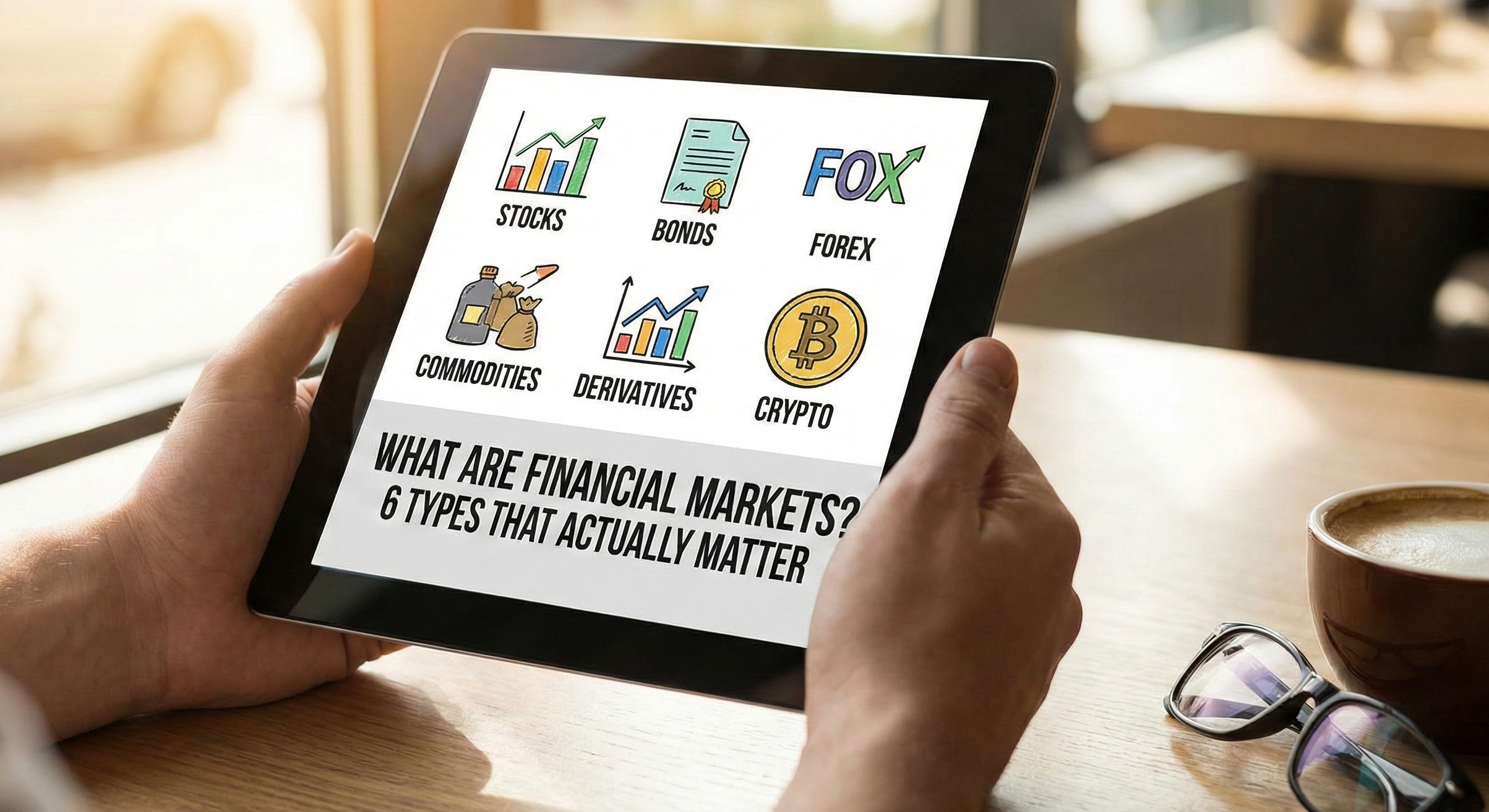
There are six main types that matter for understanding how the system works: stock markets for ownership, bond markets for lending, money markets for short-term liquidity, forex markets for currency exchange, derivatives markets for risk management, and commodity markets for raw materials.
You don’t need to master all of these. You don’t even need to participate directly in most of them. But understanding what they are and how they broadly function gives you useful context for personal finance decisions and helps you make sense of economic news that affects your life.
This isn’t about becoming a trader or an investor. It’s about financial literacy—knowing enough to navigate a world where financial markets influence everything from grocery prices to loan rates to retirement security.
Start with awareness. When you hear market terms in the news, you’ll now have a basic framework for understanding what’s being discussed. When you make financial decisions, you’ll have context for why certain options exist and how they work.
Financial markets aren’t mysterious forces working against you. They’re systems that serve specific functions in the economy. Some of those functions directly affect you. Understanding the basics helps you work with that reality rather than being confused or intimidated by it.
This knowledge won’t make you rich. It won’t eliminate financial uncertainty. But it will make you a more informed participant in an economic system that touches every aspect of your financial life. And that awareness, maintained over time, contributes to better decisions and greater financial confidence. FOLLOW FOR MORE…
This article is for educational purposes only and does not constitute financial or investment advice.



Supper 👍👍
I have bookmarked your blog and refer back to it whenever I need a dose of positivity and inspiration Your words have a way of brightening up my day
This blog is such a hidden gem I stumbled upon it by chance and now I’m completely hooked!
Deeply appreciate it!