Everyone says you need a budget. Almost no one agrees on which one.
Two methods come up more than any other — zero-based budgeting and the 50/30/20 rule.
Both are popular. Both have genuine merit. And both fail a large number of people who try them. The question worth asking is not which one is better in theory. It is which one actually works for someone living on an Indian salary, managing Indian expenses, inside the Indian cost of living.
Why Budgeting Methods Imported From the West Often Fall Short in India
Most of the popular budgeting frameworks — including the 50/30/20 rule — were developed in the context of Western economies. Stable salaries. Predictable expenses. Lower family financial obligations. A relatively simple relationship between income and outflow.
The Indian financial reality is meaningfully different.
A significant portion of middle-class Indian households carry financial responsibilities that do not fit neatly into any Western budgeting category. Remittances to parents or in-laws. Contributions to family events — weddings, festivals, ceremonies — that are not optional and not small. Medical expenses for extended family members. Education costs that begin early and run long. Informal lending within family networks.
None of these appear in the 50/30/20 rule’s three categories of needs, wants, and savings. None of them are easily accommodated by a framework that assumes your financial life begins and ends with your own household.
This is not a criticism of the frameworks themselves. They are genuinely useful structures. The problem is applying them without adjustment to a financial context they were never designed for.
Understanding this gap is the starting point for choosing a budgeting method that actually fits your life.
What Is Zero-Based Budgeting and How Does It Work
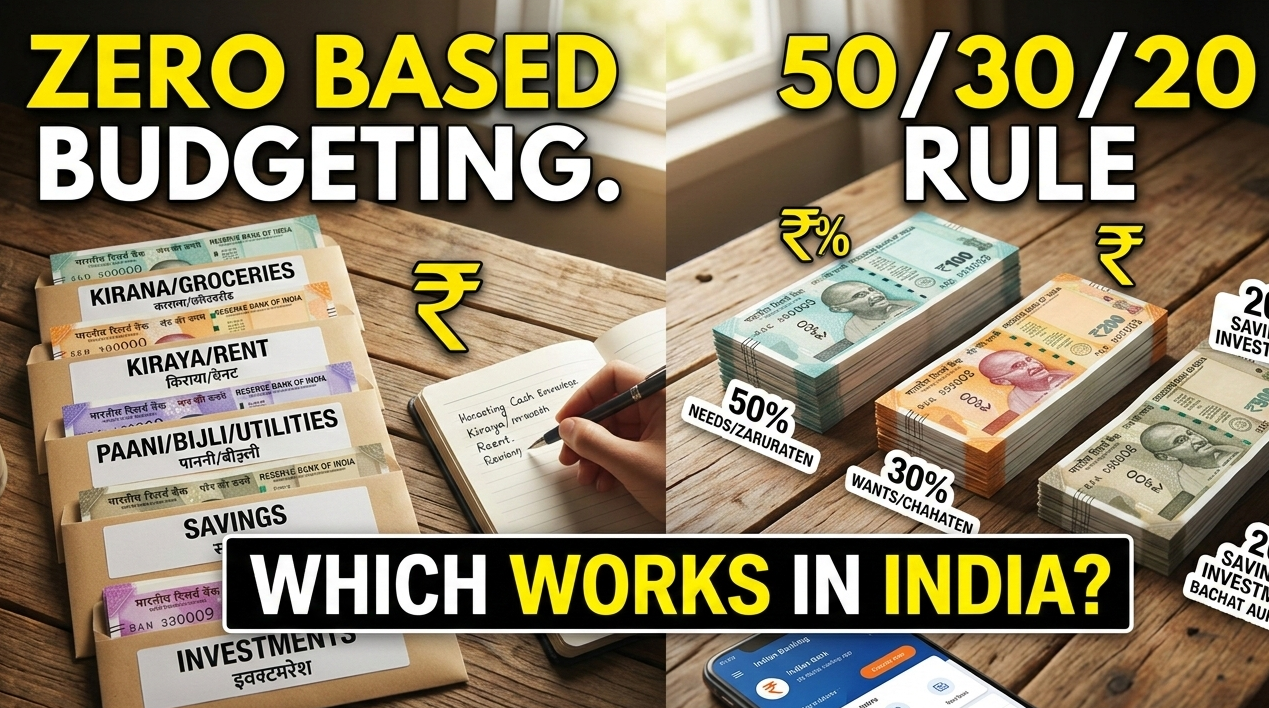
Zero-based budgeting is a method where every rupee of your income is assigned a specific purpose before the month begins. The goal is to reach zero — not by spending everything, but by accounting for everything. Savings, investments, and debt repayments count as assignments just as much as rent or groceries.
If your monthly income is ₹60,000, you assign all ₹60,000 across every category until nothing is unallocated. The discipline of the method comes from that zero. Every rupee has a job.
What Makes Zero-Based Budgeting Effective
The core strength of zero-based budgeting is intentionality. You cannot accidentally overspend a category because you have already decided, in advance, how much goes there. There is no vague “miscellaneous” pile that quietly grows. Everything is named and assigned.
This method works particularly well for people with irregular expenses, variable incomes, or complex financial obligations. In the Indian context, where family-related expenses are real and significant, zero-based budgeting allows you to create a specific category for them. You are not forcing your life into someone else’s framework. You are building your own from scratch each month.
Where Zero-Based Budgeting Gets Difficult
The same intentionality that makes it powerful also makes it demanding. Zero-based budgeting requires you to sit down at the beginning of every month and rebuild your entire allocation from scratch. It requires tracking throughout the month to ensure you are staying within each category. It requires adjustment when unexpected expenses arrive.
For someone new to budgeting, or someone with a genuinely unpredictable income, this level of detail can feel overwhelming. The method rewards consistency and patience. It punishes inconsistency harshly, because one month of not tracking can unravel the entire structure.
What Is the 50/30/20 Rule and How Does It Work
The 50/30/20 rule divides your after-tax income into three broad categories. Fifty percent goes to needs — rent, groceries, utilities, transport, loan EMIs. Thirty percent goes to wants — dining out, entertainment, shopping, lifestyle spending. Twenty percent goes to savings and investments.
The appeal of this method is its simplicity. You do not need to track every category in detail. You just need to know which of the three buckets a purchase belongs to and whether that bucket is within its limit.
What Makes the 50/30/20 Rule Effective
For beginners who have never budgeted before, the 50/30/20 rule offers something rare — a starting point that does not require hours of setup. The three categories are broad enough to absorb most expenses without needing to make complicated decisions about classification.
The method also builds financial awareness gradually. Before the 50/30/20 rule, many people have no framework at all. Moving from no structure to this simple structure is a meaningful step forward, even if it is not a perfect fit.
Where the 50/30/20 Rule Gets Difficult in India
Here is where the Indian context becomes important. For a large portion of the middle-class Indian population, the 50/30/20 split is simply not realistic.
Consider someone earning ₹50,000 per month in a metro city. Rent alone might consume ₹15,000 to ₹18,000. Add groceries, utilities, transport, and a modest EMI, and the needs category regularly crosses 60 to 65 percent — before any family obligations are counted. The 30 percent wants category effectively does not exist. And the 20 percent savings target feels like a pressure point rather than a realistic goal.
The 50/30/20 rule works well when your needs are genuinely controllable below 50 percent. In high cost-of-living Indian cities, that threshold is difficult to maintain for average salaries. Using the rule without adjusting the percentages can leave people feeling like they are failing a budgeting method, when in reality the method was never calibrated for their situation.
What Most People Misunderstand About Both Methods
The Framework Is Not the Budget
The most common mistake people make with both zero-based budgeting and the 50/30/20 rule is treating the framework as the budget itself. They read about the method, understand the concept, and assume that understanding equals implementation.
A framework is a structure. Your actual budget is the specific numbers you put inside that structure, built from your real income and your real expenses. The framework cannot do that work for you.
Two people using the same budgeting method will have completely different budgets if their incomes, cities, family situations, and financial goals are different. The method provides the shape. You provide the substance.
Consistency Matters More Than Perfection
Many people abandon a budgeting method after one or two months because they could not follow it perfectly. They overspent a category, or an unexpected expense disrupted the plan, or life simply did not cooperate with the spreadsheet.
This is where both methods are widely misunderstood. Budgeting is not a pass-or-fail system. It is a practice. A month where you tracked imperfectly is still better than a month where you tracked nothing. A budget that is roughly right and consistently reviewed is more valuable than a perfect budget that gets abandoned in week two.
Savings Is Not What Is Left Over
Both methods treat savings as an intentional allocation, not a remainder. But most people in practice save whatever is left at the end of the month — which is often very little or nothing. This is the opposite of how both budgeting methods are designed to work.
Whether you use zero-based budgeting or the 50/30/20 rule, the underlying principle is the same: savings must be assigned at the beginning of the month, before discretionary spending begins. Not after.
A Real-Life Example Worth Considering
Consider a married professional in Pune earning ₹75,000 per month. He had tried the 50/30/20 rule twice and abandoned it both times because his needs consistently exceeded 55 percent. He felt the method did not work for him.
When he switched to zero-based budgeting, he built his own categories from scratch — including a specific line for monthly family contributions and a separate category for irregular annual expenses averaged across twelve months. His savings allocation stayed the same, but it was now a named category he funded first. Within three months, he had more clarity about his finances than he had experienced in years. Not because zero-based budgeting is superior — but because it fit his actual life better than a fixed-percentage framework did.
Zero-Based Budgeting vs 50/30/20 Rule — A Direct Comparison for Indian Readers
Complexity and Time Required
Zero-based budgeting requires more time and attention. You are building a custom allocation every month and tracking it throughout. The 50/30/20 rule is significantly simpler to set up and maintain. For someone with limited time or new to budgeting, this difference matters.
Flexibility for Indian Financial Obligations
Zero-based budgeting wins clearly here. Because you build the categories yourself, you can accommodate any financial obligation your life actually contains — family remittances, festival expenses, informal contributions. The 50/30/20 rule forces these into existing categories where they often do not fit naturally.
Effectiveness at Different Income Levels
At lower to mid income levels in urban India, the 50/30/20 split is often unrealistic. Zero-based budgeting does not impose a percentage structure, making it more adaptable across income levels. At higher income levels where needs are comfortably below 50 percent, the 50/30/20 rule becomes more workable.
Suitability for Beginners
The 50/30/20 rule is better for absolute beginners. Its simplicity creates a starting point without overwhelming detail. Zero-based budgeting is better for people who have tried simpler methods and found them too vague to be useful.
Variable Income
For freelancers, self-employed individuals, or anyone with an income that changes month to month, zero-based budgeting is significantly more practical. The 50/30/20 rule assumes a stable income to percentage against. When that income varies, the percentages shift unpredictably.
What Actually Works — and Why It Is Not About Choosing the Right Method
Here is the honest answer that most budgeting articles avoid giving.
Neither method works if you do not use it consistently. Both methods work if you adapt them to your actual life and review them regularly.
The question is not zero-based budgeting vs 50/30/20 rule in abstract terms. The question is which structure you will actually maintain for more than two months. That answer depends entirely on your personality, your income stability, your financial complexity, and how much time you are willing to invest in the process.
Some people need the detailed control of zero-based budgeting to feel financially grounded. Others find that level of detail suffocating and are better served by the broad simplicity of the 50/30/20 framework, even with adjusted percentages.
The right budgeting method is the one that reflects your real life and that you will return to consistently — not the one that looks most impressive on paper.
Clear Takeaway: Start Where You Are, Not Where the Framework Assumes You Are
The zero-based budgeting vs 50/30/20 rule debate is ultimately a question of fit, not quality. Both are legitimate, well-tested approaches to monthly financial planning. Both have helped real people build financial clarity and long-term stability.
For most Indian middle-class readers, the 50/30/20 rule offers a useful entry point — provided you adjust the percentages to reflect your actual cost of living rather than treating the 50/30/20 split as a rule that cannot be modified. A 65/15/20 split might be a far more honest starting point for someone in Mumbai or Bengaluru.
Zero-based budgeting offers more power and flexibility for people willing to invest the time. It accommodates the complexity of Indian financial life better because it has no preset categories. You build the structure around your reality rather than fitting your reality into a preset structure.
Either way, the starting point is the same — honest visibility into your actual income and your actual expenses. Without that foundation, no framework will work, regardless of how well-designed it is.
A Final Thought on Patience and the Long Game
Budgeting is not a problem you solve once. It is a habit you build over time. The first month will be imperfect. The second month will be better. By the sixth month, reviewing your budget will feel less like a chore and more like a natural part of how you manage your life.
The real value of any budgeting method — whether zero-based budgeting or the 50/30/20 rule — is not the spreadsheet it produces. It is the relationship with your own money that it builds over time. A calm, clear, honest relationship where you know what is coming in, what is going out, and why.
That relationship, built slowly and maintained consistently, is what long-term financial stability actually looks like. Not a perfect budget. Not a rigid framework. Just honest attention, month after month, adjusted as life changes.
That is what works. In India, and everywhere else. FOLLOW FOR MORE..