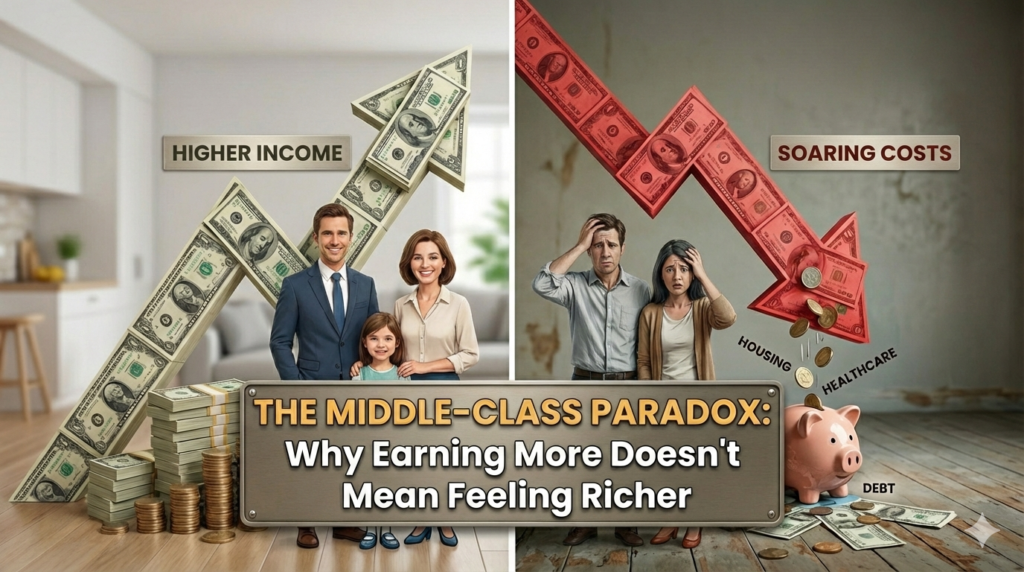
Ten years ago, earning ₹50,000 a month felt like stability.
Today, even families earning ₹1 lakh feel one emergency away from stress.
What many families are experiencing today is not a lack of income, but growing middle-class financial stress caused by rising costs, lifestyle pressure, and long-term EMIs.
Most middle-class families are earning more than ever before —
yet very few feel richer, safer, or more relaxed.
So where is the money really going?
Understanding Middle-Class Financial Stress Today
Middle-class financial stress is not caused by a single bad decision or a sudden crisis. It builds slowly, often while life appears to be improving. Higher income brings higher expectations, larger fixed expenses, and long-term commitments that quietly reduce flexibility. Over time, money stops feeling like a tool and starts feeling like an obligation.
What makes middle-class financial stress especially difficult is that it rarely looks like failure. Bills are paid on time, lifestyles look stable, and incomes continue to rise. Yet there is little room for mistakes, emergencies, or rest. One unexpected expense can disrupt carefully balanced finances. This constant pressure explains why many families feel anxious despite earning more. The stress comes not from lack of effort, but from a system where rising income is matched by rising responsibility at every step.This kind of middle-class financial stress doesn’t come from reckless spending. It builds slowly when higher income is matched by higher obligations, leaving little room for flexibility or long-term security
The Illusion of Progress
On the surface, life looks better:
- Salaries have increased
- Homes are bigger
- Cars are newer
- Technology is everywhere
But beneath this visible progress lies a quieter, more uncomfortable truth.
Savings feel fragile.
Expenses feel permanent.
Financial freedom feels delayed.
Earning more money didn’t bring freedom.
It quietly brought new responsibilities
Inflation Didn’t Just Raise Prices — It Changed Life
Inflation isn’t only about groceries becoming expensive.
It slowly redefined what counts as normal life.
Things that once felt optional are now unavoidable:
- Smartphones for work and school
- High-speed internet
- Private education
- Better healthcare
- Monthly subscriptions
Life itself became more expensive.
Salaries grew — but basic living became premium-priced.
Lifestyle Creep: The Invisible Upgrade Trap
What makes lifestyle creep dangerous is that nothing feels reckless.
Each decision is justified by comfort, convenience, or social expectation.
No single choice breaks finances — the pattern does. No one decides to live beyond their means overnight.
It happens quietly.
A better phone because work demands it.
A bigger house because “everyone is upgrading.”
A newer car because the old one feels outdated.
Each decision feels reasonable.
Together, they lock income into fixed expectations.
Money increases — flexibility disappears.
How EMIs Changed the Meaning of Affordability
EMIs made life easier — at least on the surface.
Suddenly, everything felt affordable per month.
But something important changed.
Instead of asking:
“Can we afford this?”
We started asking:
“Can we manage the EMI?”
Future income was already spent — just divided neatly into months and forgotten.
EMIs stopped being temporary tools and became permanent How EMIs Changed the Meaning of Affordability
EMIs made life easier — at least on the surface.
Suddenly, everything felt affordable per month.
But something important changed.
Instead of asking:
“Can we afford this?”
We started asking:
“Can we manage the EMI?”
Future income was already spent —
just divided neatly into months.
EMIs stopped being temporary tools and became permanent pressure.
More Income, Less Control
Here’s the uncomfortable truth:
Most middle-class families aren’t struggling because they earn too little.
They’re struggling because their income is already committed.
- Rent.
- EMIs.
- School fees.
- Insurance.
- Subscriptions.
Money comes in — but choices feel pre-decided.
That’s why earning more no longer feels empowering.
It feels like responsibility without relief.
Why Earning More Stopped Solving the Problem
Higher income alone cannot fix:
- Rising fixed expenses
- Constant lifestyle upgrades
- Long-term financial commitments
Without breathing space, more income only supports
a more expensive version of the same stress.
This is why people with decent salaries still fear:
- Emergencies
- Job loss
- Health issues
- The future
What Actually Makes Families Feel Richer
Feeling rich has less to do with numbers and more to do with control.
Families feel secure when:
- Fixed expenses don’t dominate income
- One setback doesn’t collapse everything
- Choices still exist
Often, this security comes not from earning more —
but from keeping life simpler than income allows.
The Real Takeaway
Earning more money didn’t fail the middle class.
Inflation quietly raised the cost of normal life.
Lifestyle creep normalized constant upgrades.
EMIs turned future income into present pressure.
Together, they changed how money feels.
Until income growth is matched with breathing space,
many families will keep earning more —
while feeling no closer to true security.
Final Thought
The goal was never just to earn more.
It was to sleep without financial anxiety.
To handle emergencies without fear.
To feel in control of the future.
Until income growth brings that freedom,
earning more will continue to feel like running harder — not moving forward. FOR MORE