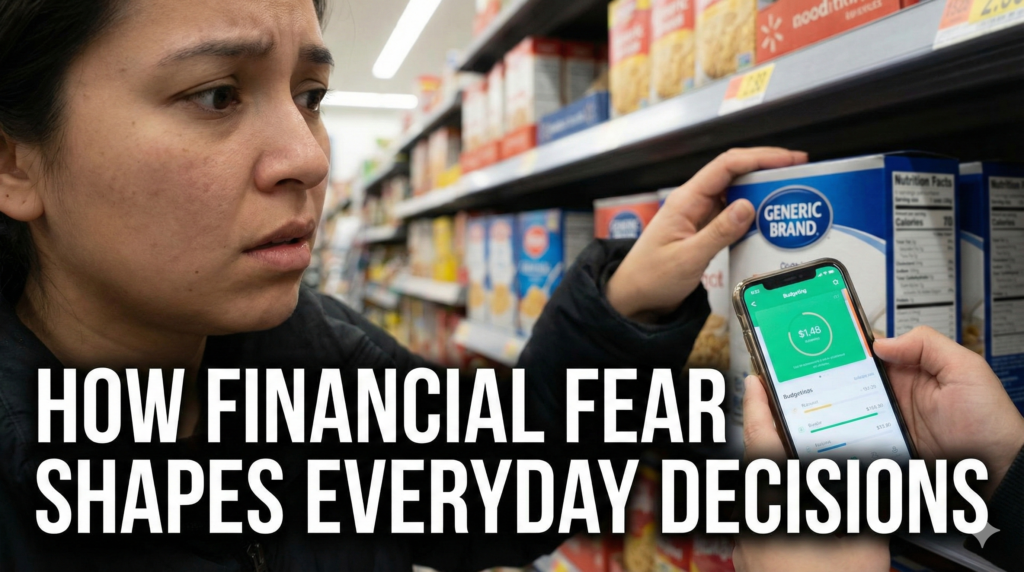
You stand in the grocery store, debating between two brands. One costs less. The other is what you actually want. The difference is two dollars, yet the choice feels weighted with something larger than logic.
That weight is financial fear, and it influences far more of your daily life than you might realize.
The Invisible Force Behind Your Choices
Financial fear doesn’t always announce itself with panic or obvious anxiety. More often, it operates quietly in the background of ordinary moments. It’s the hesitation before clicking “purchase.” The extra minute spent calculating whether you can afford something you’ve already budgeted for. The mental gymnastics that happen when a friend suggests dinner at a restaurant you know is slightly beyond comfortable.
These small moments of fear-based decision-making accumulate into patterns that shape how you move through the world. They influence what opportunities you pursue, what experiences you allow yourself, what risks you’re willing to take, and what vision you hold for your future.
Understanding how financial fear shapes everyday decisions isn’t about eliminating the emotion entirely. Fear serves important protective functions. Rather, it’s about recognizing when fear is providing useful information versus when it’s constraining your choices beyond what circumstances actually require.
Where Financial Fear Comes From
Financial fear develops through a combination of direct experience, observed patterns, and cultural messaging. If you’ve experienced genuine financial hardship—periods of unemployment, overwhelming debt, or stretches where meeting basic needs felt uncertain—your nervous system remembers. Even after circumstances improve, the body’s threat detection system remains sensitized to anything that might signal a return to that vulnerable state.
But you don’t need firsthand experience of financial crisis to develop financial fear. Watching parents struggle with money creates lasting impressions. Children who grew up in households where financial stress was constant often carry that anxiety into adulthood, even when their own financial situations are more stable.
The broader economic environment contributes as well. Living through recessions, witnessing mass layoffs, watching housing markets collapse, or seeing retirement accounts disappear creates collective anxiety that persists long after recovery begins. These events reshape how entire generations think about financial security.
Cultural narratives about money add another layer. Messages about the dangers of debt, the importance of frugality, the virtue of financial independence, and the shame of needing help all influence how we emotionally process financial decisions. Some of these messages contain wisdom. Others create unnecessary anxiety that doesn’t serve our actual wellbeing.
The Daily Expression of Financial Fear
Financial fear manifests in countless small decisions throughout ordinary days. It appears in how you approach your morning coffee routine—making it at home even when you genuinely want the experience of a café, not because of budgetary necessity but because of ambient anxiety about spending.
It shows up in grocery shopping patterns. You might buy the cheaper versions of everything by default, without actually calculating whether you can afford the preferred options. Or you might avoid certain stores entirely based on assumptions about cost rather than actual price comparison.
The fear influences social decisions. Declining invitations because they might involve spending money, even when the actual cost would fit comfortably in your budget. Suggesting cheaper alternatives for group activities not because of real financial constraint but because of discomfort with any discretionary spending.
It affects professional choices. Staying in jobs that feel safe but unfulfilling because the fear of income disruption outweighs dissatisfaction with current work. Avoiding career transitions that could improve long-term prospects because short-term financial uncertainty feels intolerable.
Financial fear shapes how you maintain your living space and possessions. Delaying necessary repairs or replacements beyond the point of practicality because spending money on maintenance triggers anxiety, even when the delay ultimately costs more.
It influences healthcare decisions. Postponing medical appointments, skipping preventive care, or trying to manage symptoms without professional input because of fear about costs, even when insurance would cover the care or the expense would be manageable.
The Paradox of Financial Fear in Stability
One of the most confusing aspects of how financial fear shapes everyday decisions is that it often persists even when objective circumstances improve. People who have achieved financial stability—steady income, adequate savings, manageable expenses—frequently continue operating from the same fear-based decision-making patterns they developed during less secure periods.
This persistence happens because fear-based patterns become deeply ingrained behavioral habits. Your brain creates shortcuts to protect you from perceived threats. When those shortcuts repeatedly activate in response to financial decisions, they become automatic. You stop consciously evaluating whether the fear is proportional to current reality.
The paradox creates a painful situation: you work hard to achieve financial security, then that security doesn’t deliver the psychological relief you expected because the fear-based patterns remain active regardless of changed circumstances.
Sarah, a nurse practitioner in her mid-forties, experienced this disconnect acutely. She had grown up in a household where money was perpetually scarce and anxiety-inducing. By her forties, she earned a solid income, had built meaningful savings, and lived well within her means. Yet she still experienced intense anxiety when spending money on anything beyond strict necessities. She would agonize over purchasing a thirty-dollar book she wanted, despite having thousands in discretionary funds. The fear that shaped decisions during childhood scarcity continued shaping decisions during adult stability, creating suffering that no longer matched her actual financial reality.
How Financial Fear Distorts Risk Assessment
Fear fundamentally changes how we evaluate risk and opportunity. Under the influence of financial fear, potential losses loom much larger than equivalent potential gains. This isn’t irrational—loss aversion is a well-documented aspect of human psychology. But when fear is elevated beyond what circumstances warrant, it skews the calculation in ways that limit possibility.
Someone operating from significant financial fear might see a job opportunity that offers higher compensation but requires relocation as impossibly risky, even when the practical risks are minimal and manageable. The fear amplifies worst-case scenarios—what if the new job doesn’t work out, what if the cost of living is higher than expected, what if, what if, what if—until the safer option feels like the only reasonable choice.
This distorted risk assessment affects educational decisions. Going back to school or pursuing additional training involves upfront costs and potential debt, elements that trigger financial fear intensely. Even when the long-term career and earning benefits clearly outweigh the short-term costs, the fear makes the risk feel unacceptable.
It influences entrepreneurial thinking. Starting a business inherently involves financial uncertainty. For someone with high financial fear, that uncertainty feels categorically intolerable regardless of the specific circumstances, business model, or safety nets in place. The fear eliminates entire categories of possibility before rational evaluation can occur.
The distortion works in reverse as well. Financial fear can lead to excessively conservative financial behaviors that themselves carry risk. Keeping all savings in low-return accounts because investment feels too scary means losing purchasing power to inflation over time. Avoiding all debt regardless of context means missing opportunities where strategic borrowing would improve long-term outcomes.
The Relationship Between Control and Fear
Much of how financial fear shapes everyday decisions relates to control—or more accurately, to the feeling of lacking control. Money represents security and autonomy in modern life. When financial stability feels uncertain, many other aspects of life feel uncertain as well.
This drives compensatory control-seeking in the domains where control feels possible. You might not be able to control whether your employer will eliminate your position, but you can control whether you buy the name-brand or generic version of household items. You might not be able to control broader economic conditions, but you can control every discretionary dollar you spend.
The problem is that this type of control-seeking often becomes excessive relative to actual threat. Micromanaging every small expense creates an illusion of security while generating constant stress. The emotional energy spent making fear-based decisions about minor purchases rarely translates into meaningful improvement in financial outcomes.
Paradoxically, excessive control-seeking born from financial fear can actually reduce your capacity for financial resilience. When you’re rigidly controlling every small decision, you have less mental and emotional bandwidth to address larger strategic questions about income, career development, or building genuine financial stability.
Social Dimensions of Financial Fear
How financial fear shapes everyday decisions doesn’t happen in isolation. Money exists in social context, and financial fear often intertwines with social anxiety in complex ways.
There’s fear about others judging your financial choices. This might manifest as either excessive frugality to avoid appearing wasteful or excessive spending to avoid appearing financially struggling. Both patterns are driven by concern about social perception rather than actual financial strategy.
Financial fear affects relationship dynamics. Difficulty discussing money openly with partners, family members, or friends often stems from fear—fear of judgment, fear of conflict, fear of revealing vulnerability, fear of disappointing people, fear of losing relationships if financial struggles become known.
It influences parenting decisions. Fear about providing adequately for children can drive both overextension (spending beyond comfortable means to give kids experiences or possessions) and excessive restriction (denying children normal experiences due to exaggerated fear about costs).
The social comparison aspect of financial fear has intensified with constant exposure to others’ apparent financial success through social media. Seeing curated presentations of others’ lives—vacations, purchases, experiences—can trigger fear that you’re falling behind financially, even when you’re actually doing fine by objective measures.
The Information Paradox
You might assume that more financial information would reduce financial fear by enabling more informed decisions. Sometimes this is true. Understanding your actual financial picture—income, expenses, savings, debts—can alleviate anxiety born from uncertainty.
But for many people, more information increases fear rather than reducing it. Reading about economic trends, market volatility, potential recessions, or financial risks can amplify anxiety. Personal finance content, even when well-intentioned, often has an undercurrent of “you should be worried about this” that feeds fear rather than alleviating it.
This creates a difficult situation. Avoiding financial information entirely leaves you potentially unprepared for genuine challenges. Consuming too much financial information, especially content designed to capture attention through urgency and concern, can elevate fear to counterproductive levels.
The relationship between information and fear varies significantly between individuals. Some people feel more secure with detailed knowledge and extensive planning. Others find that detailed financial planning triggers obsessive worry. Neither response is wrong—they’re different psychological relationships with uncertainty and control.
When Fear Prevents Necessary Action
While financial fear often manifests as excessive caution, it can paradoxically also prevent important financial actions. Anxiety about confronting financial reality can lead to avoidance behaviors that ultimately worsen situations.
Someone might avoid checking their bank account balance because they fear what they’ll see. This avoidance prevents them from having accurate information needed for good decisions, potentially leading to overdrafts or missed payments that could have been avoided.
Fear about investment losses might prevent someone from even looking at retirement account statements during market downturns. This avoidance prevents them from making rational decisions about whether their allocation still matches their long-term strategy.
Anxiety about dealing with debt might lead to avoiding calls from creditors or ignoring collection notices. This avoidance eliminates opportunities for negotiation or payment plans that could improve the situation.
Fear about inadequacy might prevent someone from seeking professional financial guidance even when they clearly need it. The prospect of revealing their full financial situation to someone else triggers shame and anxiety that outweighs the potential benefit of expert assistance.
The Exhaustion Factor
Living with persistent financial fear is exhausting in ways that aren’t always obvious. Every decision that could have been straightforward instead requires emotional labor. Every purchase becomes a minor stress event. Every financial choice carries weight beyond its actual significance.
This constant low-level stress accumulates over time. Decision fatigue sets in. The mental energy spent managing financial anxiety becomes unavailable for other aspects of life that matter—creative thinking, relationship attention, personal development, simple enjoyment.
The exhaustion can create a feedback loop. Financial stress reduces your capacity for strategic thinking and planning. Reduced capacity for planning can lead to suboptimal financial outcomes. Those outcomes then reinforce the original fear, increasing stress further.
Breaking this cycle requires recognizing the pattern and consciously interrupting it, which itself requires energy that stress has depleted. This is part of why financial fear can feel so intractable even when people understand intellectually that their anxiety isn’t proportional to their circumstances.
Cultural and Generational Patterns
How financial fear shapes everyday decisions varies across cultures and generations in ways that reflect different historical experiences and cultural values. Generations that lived through severe economic hardship often carry financial caution throughout their lives, sometimes passing those patterns to children who didn’t experience the original hardship firsthand.
Cultural attitudes toward debt, saving, family financial responsibility, and material success shape the specific manifestations of financial fear. In some cultural contexts, the fear centers on family obligation and providing for extended family. In others, it focuses on individual independence and avoiding any financial interdependence.
Economic conditions during formative years create lasting patterns. People who entered adulthood during recessions often show more conservative financial behavior decades later compared to those who entered adulthood during prosperous periods. The fear imprinted during vulnerable early career years shapes decisions long after circumstances improve.
Understanding these patterns doesn’t eliminate their influence, but it provides context. Recognizing that some of your financial fear may be inherited rather than fully based on your current reality can create space for questioning which fear-based patterns genuinely serve you.
The Role of Scarcity Thinking
Financial fear often operates through scarcity thinking—a mental framework that assumes resources are fundamentally limited and every use of money means permanently losing something that can’t be replaced. While money is technically limited at any given moment, scarcity thinking extends beyond accurate assessment of current resources into a worldview where “not enough” is the fundamental condition.
Under scarcity thinking, spending money on yourself feels selfish because resources are precious and limited. Investing in experiences feels wasteful because money spent on intangibles is money lost forever. Taking financial risks feels categorically dangerous because there won’t be enough resources to recover from setbacks.
This mindset affects not just spending decisions but earning decisions as well. Scarcity thinking can make you undervalue your own work, hesitate to negotiate compensation, or stay in underpaid positions because you fear that asking for more might result in having less.
The alternative to scarcity thinking isn’t naive abundance thinking that ignores real constraints. It’s realistic assessment of actual resources combined with recognition that money, unlike time, is renewable. You can earn more. Resources can be replenished. Setbacks can be recovered from. This doesn’t mean money is unlimited, but it does mean money isn’t as permanently scarce as scarcity-based fear suggests.
Physical Manifestations
How financial fear shapes everyday decisions isn’t purely psychological. The fear manifests physically in ways that affect wellbeing beyond the financial domain. The stress of persistent financial anxiety shows up as muscle tension, disrupted sleep, digestive issues, headaches, and elevated baseline stress hormones.
These physical manifestations create their own problems. Poor sleep reduces decision-making capacity. Chronic stress impacts physical health. The bodily experience of fear reinforces the psychological experience, creating a mind-body feedback loop that intensifies the overall anxiety.
Recognizing the physical dimension matters because it highlights that financial fear isn’t just “in your head” in the dismissive sense. It’s a full-system response that deserves acknowledgment and, where possible, support. Sometimes addressing the physical manifestations—through whatever stress-management approaches work for you personally—can slightly reduce the overall anxiety level enough to enable more flexible thinking about financial decisions.
Breaking Automatic Patterns
The power of financial fear to shape everyday decisions lies partly in its automatic nature. Most fear-based financial behaviors happen without conscious deliberation. You don’t decide to feel anxious about a purchase—the anxiety simply arises. You don’t choose to hesitate—the hesitation happens reflexively.
Creating space between the trigger and the response offers a pathway toward more intentional decisions. This doesn’t mean eliminating the fear—fear often contains useful information about values and priorities. It means creating enough pause to assess whether the fear is proportional to the situation and whether the decision you’re about to make actually serves your wellbeing.
That space can be as simple as noticing the fear when it arises. “I notice I’m feeling anxious about this expense.” That small act of observation creates distance. From that slightly distanced perspective, you can ask whether the fear is signaling something important or whether it’s a habitual response that doesn’t match current reality.
For some people, developing specific decision-making frameworks helps interrupt automatic fear-based patterns. For instance, deciding in advance that any purchase under a certain threshold doesn’t require extensive deliberation. Or establishing that certain categories of spending—like healthcare or education—are automatically approved as investments in wellbeing rather than analyzed through a fear lens.
The goal isn’t to override all fear-based hesitation. Sometimes the hesitation is appropriate. The goal is to create enough conscious awareness that you’re choosing your response rather than having it chosen by automatic patterns developed under different circumstances.
The Relationship Between Fear and Values
Financial decisions always involve values, whether we acknowledge that explicitly or not. How you use money reflects what matters to you. Financial fear complicates this relationship by introducing emotions that can override value-based decision making.
You might value education highly, but financial fear prevents you from taking a class you’d find meaningful. You might value relationships, but fear about money leads you to decline social invitations. You might value health, but anxiety about expenses keeps you from seeking needed care.
When fear-based decisions consistently contradict your actual values, the result is a particular kind of distress. You’re not living in alignment with what matters to you, not because circumstances genuinely prevent it, but because fear is overriding your values in moment-to-moment decisions.
Reconnecting financial decisions with values requires deliberately identifying what genuinely matters to you beyond financial accumulation itself. Money is a tool, not an end goal. When financial fear becomes so prominent that preserving money takes precedence over using it in service of your actual values, the fear has exceeded its useful function.
This doesn’t mean spending carelessly. It means ensuring that the constraints you place on spending are based on realistic assessment of resources and conscious prioritization of values, not on automatic fear responses that may not serve your actual wellbeing.
Accepting Reasonable Fear
Not all financial fear is problematic. Some financial caution is adaptive and protective. The challenge is distinguishing between fear that appropriately signals genuine risk versus fear that constrains choices beyond what circumstances require.
Feeling concerned about taking on debt with unclear repayment capacity—that’s reasonable fear providing useful information. Feeling anxious about any purchase regardless of your financial situation—that’s likely excessive fear that warrants questioning.
Hesitating before making a major financial commitment like buying a house or changing careers—that’s appropriate deliberation. Agonizing over every minor expense—that’s exhausting micromanagement that doesn’t meaningfully improve outcomes.
Part of developing a healthier relationship with financial fear involves accepting that some fear is normal and even helpful. You don’t need to eliminate all financial anxiety. You need to calibrate the fear to match actual circumstances rather than worst-case scenarios.
This calibration is individual. Someone with genuinely precarious finances needs more financial caution than someone with substantial stability. The question isn’t whether you should feel any financial fear, but whether the level of fear you’re experiencing is proportional to your actual situation and whether the decisions driven by that fear serve your overall wellbeing.
The Long Path of Adjustment
Changing how financial fear shapes everyday decisions isn’t a quick process. Patterns developed over years or decades don’t resolve in weeks. This is important to acknowledge because expecting rapid change often leads to frustration when change happens gradually.
The adjustment happens through accumulated small shifts in awareness and response. You notice the fear. You pause slightly before acting on it automatically. You occasionally choose differently than the fear suggests. You reflect on whether fear-based decisions actually made you feel more secure or just perpetuated anxiety.
These small adjustments accumulate slowly into different patterns. The timeline varies enormously between individuals based on the depth of the original fear, current circumstances, and available support. For some people, meaningful shifts happen over months. For others, it’s years. Neither timeline reflects personal failure—they simply reflect different starting points and different intensities of the original fear.
Progress isn’t linear. You’ll have periods where you feel you’re making headway, then situations that trigger old fear-based responses as intensely as ever. This isn’t regression—it’s normal variation in a gradual process of change. The goal isn’t perfection or complete elimination of financial fear. It’s slowly expanding your range of possible responses so fear isn’t the only factor shaping decisions.
Finding Your Balance
How financial fear shapes everyday decisions is deeply personal. The same level of financial caution might be appropriate for one person’s circumstances and excessive for another’s. The same pattern that serves someone well in one life phase might become constraining in another.
There’s no universal correct relationship with financial fear. What matters is whether your current patterns serve your overall wellbeing—not just financial wellbeing, but the full texture of your life including relationships, health, personal development, and simple enjoyment.
This requires honest self-assessment. Are your fear-based financial decisions creating genuine security, or are they creating the illusion of security while actually diminishing your quality of life? Are you protecting yourself from realistic risks, or are you protecting yourself from uncomfortable emotions at the cost of opportunities and experiences that align with your values?
These aren’t questions with simple answers. The balance shifts as circumstances change. What serves you well during a period of genuine financial vulnerability might become unnecessarily restrictive once stability is established. What feels like appropriate caution when you’re responsible only for yourself might become excessive once you have family resources to draw on.
The work is ongoing—not because you’re doing it wrong, but because the balance between appropriate caution and excessive fear genuinely does need regular recalibration as life circumstances and internal landscapes shift. Financial fear will likely always be part of your decision-making process. The question is whether it’s a voice among many or the only voice you hear. FOLLOW FOR MORE…