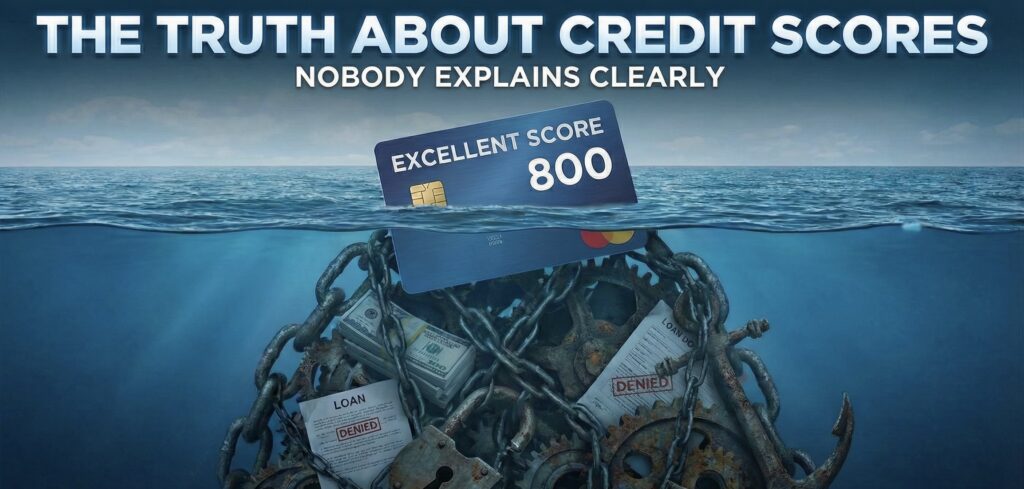
You know that three-digit number that somehow decides whether you can buy a house, lease a car, or even get approved for a decent apartment? Yeah, that one. Let’s talk about what’s really going on behind the curtain.
The Lie We’ve All Been Told
Here’s what they taught us: “Pay your bills on time, keep your credit card balance low, and your score will be fine.”
Technically true. But also? Woefully incomplete.
It’s like telling someone the secret to becoming a chef is “just cook food and don’t burn it.” You’re not wrong, but you’re leaving out about 90% of what actually matters.
The credit score system isn’t just some neutral math equation floating in the financial ether. It’s a game with specific rules, and most of us are playing it blindfolded while everyone else pretends the rules are “common sense.”
They’re not.
What Your Credit Score Actually Measures (Spoiler: Not What You Think)
Pop quiz: Does your credit score measure how responsibly you handle money?
If you answered yes, you’re in good company. You’re also wrong.
Your credit score measures how profitable you are to lenders. Full stop.
Think about it. Someone who pays off their credit card in full every month—never paying a cent in interest—might have a lower score than someone who carries a small balance and pays interest regularly. Why? Because the second person is making the credit card company money.
The system rewards you for being a reliable borrower, not a smart money manager. Those are two very different things.
Here’s the breakdown everyone glosses over:
Payment History (35%): Did you pay on time? This one’s straightforward. Miss a payment, get punished. But here’s the kicker—a single missed payment can haunt you for seven years. Seven. Years. That parking ticket you forgot about in 2019? Still judging you.
Credit Utilization (30%): This is where it gets weird. They want to see you using credit, but not too much credit. The magic number? Keep your balance under 30% of your limit. Better yet, under 10%. But if you’re at 0%—using no credit at all—that doesn’t help you either. You’re supposed to be in this Goldilocks zone of “using credit but barely.”
Length of Credit History (15%): Translation: the system punishes young people. You can be financially responsible your entire adult life, but if you’re 23, you simply haven’t existed long enough to have a “good” score. Meanwhile, someone who opened a credit card at 18 and forgot about it? They’re golden.
Credit Mix (10%): The system wants to see you juggling different types of debt—credit cards, car loans, student loans, maybe a mortgage. Because apparently, being in multiple forms of debt simultaneously is a sign of… responsibility? The logic is fuzzy at best.
New Credit (10%): Apply for too many cards? Score drops. Don’t apply for any new credit in years? Also suspicious. You’re supposed to be constantly, moderately interested in new debt. Not too hungry, not too satisfied.
The Paradoxes Nobody Mentions
Here’s where your brain starts to hurt:
Paradox #1: Closing a credit card can destroy your score. You’d think paying off and closing an account would be celebrated. Nope. It reduces your available credit, which increases your utilization ratio, which tanks your score. The reward for becoming debt-free? Punishment.
Paradox #2: Having no debt can lower your score. If you’ve paid off everything and haven’t used credit in a while, your score can actually drop. The system interprets financial independence as “lack of recent data.” You’re being graded on a test you’re not taking.
Paradox #3: Shopping for the best loan rate can hurt you. Every time a lender checks your credit (a “hard inquiry”), your score takes a small hit. So if you’re trying to be a responsible consumer and compare mortgage rates from five different banks, you’re punished for it. There’s a grace period for rate shopping, but most people don’t know about it.
Paradox #4: The system rewards risk-taking. Someone with ten credit cards and a car loan might have a better score than someone who lives within their means and uses one debit card for everything. The person avoiding debt entirely? Invisible to the system. Unscoreable. Untrustworthy, ironically.
The Dark Secret: Different Scores for Different People
You know how you have a credit score?
You don’t.
You have dozens of credit scores.
There’s FICO (with about 28 different versions), VantageScore, and industry-specific scores for mortgages, auto loans, and credit cards. The score your credit card app shows you might be completely different from the one a car dealership sees.
It’s like being graded on different curves by different teachers who refuse to talk to each other.
And here’s the part that’ll make your eye twitch: the free score you check on Credit Karma or through your bank? That’s often a VantageScore. But when you apply for a mortgage? They’re probably using FICO 2, 4, or 5—which could be 50+ points different.
You’re essentially preparing for one test while being graded on another.
The Stuff That Seems Like It Should Matter (But Doesn’t)
Your income? Not factored in.
Your savings account? Irrelevant.
Your assets? Don’t care.
Your rent payment history? Mostly ignored (though this is slowly changing).
How much you actually owe? Only matters in relation to your limits, not actual dollars.
You could be a millionaire with $500K in the bank, but if you don’t have active credit accounts, your score could be mediocre. Meanwhile, someone drowning in debt but making minimum payments on time could have an excellent score.
The system doesn’t measure wealth. It doesn’t measure financial literacy. It measures your relationship with debt.
Why This Matters More Than Your GPA Ever Did
Here’s the uncomfortable truth: your credit score affects more of your life than almost any other number.
Jobs: Some employers check credit scores during hiring. Bad credit? You might not get the job. (The logic here is especially circular: “You’re in financial trouble, so we won’t hire you, which will keep you in financial trouble.”)
Housing: Landlords use credit scores to screen tenants. Low score? Higher deposit, or outright rejection. In competitive rental markets, your credit score can be the difference between housing and homelessness.
Insurance rates: In most states, insurers use credit-based insurance scores to set your premiums. Bad credit can mean paying hundreds more per year for the exact same car insurance.
Utility deposits: Want electricity? Water? Internet? Companies check your credit to decide if you need to put down a deposit first.
Loan approval and interest rates: This is the obvious one, but the impact is staggering. The difference between “excellent” and “good” credit on a 30-year mortgage can be tens of thousands of dollars in interest.
Your credit score is essentially your financial reputation score, and it follows you everywhere.
What You Can Actually Do About It (The Real Strategies)
Alright, enough doom and gloom. Here’s what actually works, stripped of the corporate doublespeak:
Strategy 1: The Authorized User Hack
Know someone with old, well-maintained credit? Ask them to add you as an authorized user on their card. You don’t even need access to the card—just being associated with their good history can boost your score. It’s like borrowing someone else’s credit reputation.
Strategy 2: The Balance Timing Game
Credit card companies report your balance to credit bureaus on a specific day each month (usually your statement closing date). Pay down your balance before that date, not just before the due date. Your reported utilization will be lower, even if you pay in full every month.
Strategy 3: Keep Old Accounts Alive
That credit card you opened in college and never use? Don’t close it. Put one small recurring charge on it (like a Netflix subscription), set up autopay, and forget about it. The age of that account is helping your score.
Strategy 4: The Credit Limit Increase Request
Every 6-12 months, request a credit limit increase on your existing cards. If you don’t increase your spending, this automatically lowers your utilization ratio. Some issuers do this as a soft pull (doesn’t hurt your score), but always ask first.
Strategy 5: Dispute Everything Questionable
Check your credit report (free at annualcreditreport.com) and dispute anything that looks wrong. The credit bureaus have 30 days to verify items. If they can’t, it gets removed. Companies bet on you not checking.
Strategy 6: The “Pay for Delete” Negotiation
If you have collections, try negotiating a “pay for delete”—you pay the debt, they remove it from your report. Get it in writing before you pay. Not all collectors will do this, but many will if you ask.
Strategy 7: Become a Credit Card Churner (Carefully)
This is advanced mode: Open new cards strategically for signup bonuses, but space them out. The temporary hit from hard inquiries is usually offset by the increase in available credit. But only if you’re disciplined enough not to actually use that credit.
The Philosophical Problem Nobody Wants to Address
Here’s what keeps me up at night about credit scores:
We’ve created a system that requires you to go into debt to prove you can handle debt.
It’s like requiring someone to get punched in the face repeatedly to prove they can take a punch. Technically logical within its own framework, but absurd when you zoom out.
Young people, immigrants, and anyone who’s been financially responsible by avoiding debt are systematically punished. The system assumes that having no credit history means you’re risky, when it might just mean you’re careful.
And the kicker? The companies that create these scores are private corporations. Equifax, Experian, TransUnion—these aren’t government agencies. They’re for-profit businesses that profit from the data they collect about you, without your explicit consent, and then charge you to see that data.
You’re the product, and you don’t even get paid.
The Future (Maybe)
There’s growing momentum toward alternative credit scoring—systems that consider rent payments, utility bills, and banking history. Some fintech companies are pioneering models that look at cash flow instead of debt history.
But here’s the reality: the current system works perfectly for those in power. Banks make money. Credit bureaus make money. The people hurt by it—young adults, immigrants, the historically marginalized—don’t have enough lobbying power to change it.
Change will come slowly, if at all.
The Bottom Line
Your credit score is not a moral judgment. It’s not a measure of your worth as a person or even your financial competence.
It’s a tool created by lenders to assess how profitable you’ll be to them.
Once you understand that, the whole game changes. You stop taking it personally when the system seems illogical. You stop feeling shame about a number that was never designed to be fair.
And you start playing the game strategically, with full knowledge of the rules.
Will you game the system? That’s up to you. But at least now you know what the system actually is.
And maybe, just maybe, we can start having honest conversations about whether this is really the best way to run a financial society.
Spoiler alert: it’s probably not.
Your credit score is a game. You didn’t choose to play it, but you’re playing it whether you like it or not. Might as well know the rules.
What’s the most frustrating thing about your credit score experience? The thing that made you realize the system isn’t quite what they taught us? I’d love to hear it. FOLLOW FOR MORE…..