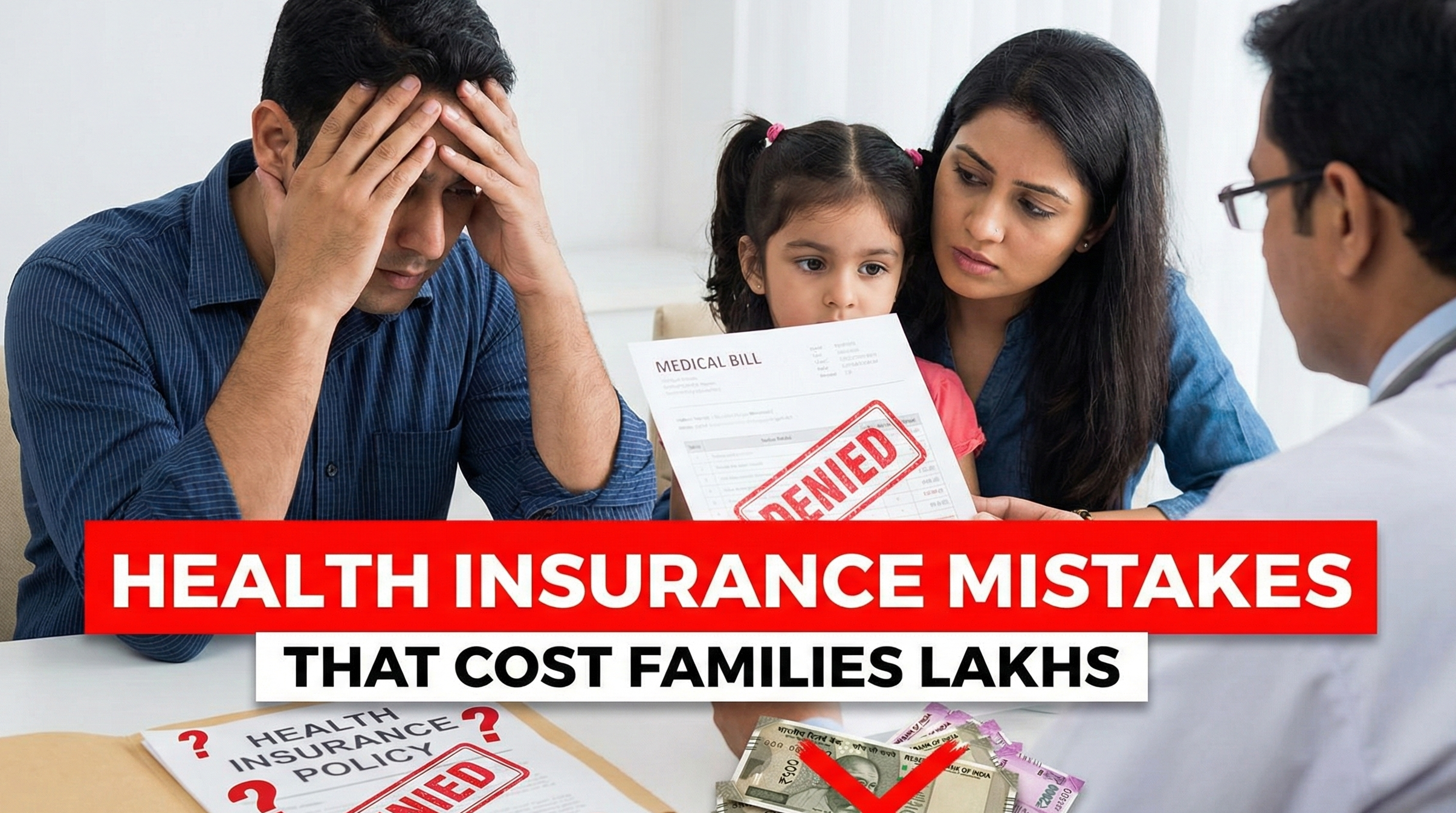
Rajesh thought he was being smart. He’d compared policies online, chosen the cheapest one with decent coverage, and felt proud of saving ₹8,000 on annual premiums.
Then his wife needed surgery.
The hospital bill came to ₹4.2 lakhs. His insurance paid ₹1.8 lakhs. The remaining ₹2.4 lakhs? That came from their daughter’s education fund, his emergency savings, and a loan from his brother-in-law.
The ₹8,000 he saved cost him ₹2.4 lakhs. Plus his peace of mind. Plus family relationships strained by borrowed money.
He’s not alone. Every day, families across India discover that their “comprehensive” health insurance isn’t quite as comprehensive as they thought.
The ₹50,000 Checkbox Nobody Reads
Here’s how it usually goes:
You’re buying health insurance. The agent asks, “Do you want room rent capping or no capping?”
“What’s the difference?”
“No capping costs ₹3,000 more per year.”
You do the mental math. ₹3,000 extra means ₹30,000 over ten years. That’s a decent vacation. “I’ll take the capped version.”
Congratulations. You just made a decision that could cost you ₹5-10 lakhs when you need hospitalization.
Here’s what they don’t explain clearly: Room rent capping doesn’t just cap the room cost. It caps EVERYTHING proportionately.
Your policy says ₹5,000 per day room rent limit, but you need a ₹10,000 room because that’s all the hospital has available during emergency admission?
The insurance company doesn’t just refuse to pay the extra ₹5,000 for the room. They apply a 50% reduction to EVERYTHING—surgeon fees, ICU charges, medicines, diagnostics, everything.
Your ₹4 lakh surgery bill? They’ll pay ₹2 lakhs. You’re stuck with the remaining ₹2 lakhs.
That ₹3,000 annual saving just became a ₹2 lakh nightmare.
The invisible tax: Families lose an average of ₹1.5-3 lakhs per hospitalization due to room rent capping clauses they didn’t fully understand.
The “Pre-Existing Disease” Trap That Catches Everyone
Priya bought health insurance at 28. She was healthy, active, never had any major health issues.
At 32, she got diagnosed with a thyroid condition. Started medication. Managed it well.
At 35, she needed a completely unrelated knee surgery after a sports injury.
Claim denied.
Why? The insurance company argued that hormonal imbalances from thyroid issues can affect bone density and joint health. Therefore, the knee problem was “related to a pre-existing condition.”
She fought it. They eventually paid 60% of the claim after six months of back and forth. The rest came from her savings.
Here’s the trap most people don’t know about:
Pre-existing diseases have a 2-4 year waiting period. Everyone knows that.
What they don’t tell you is how broadly insurance companies can interpret “related to” when denying claims.
Diabetes? Almost any health issue can be linked to it—infections, cardiovascular problems, kidney issues, vision problems, nerve damage.
Hypertension? Heart disease, stroke, kidney disease—all potentially “related.”
Thyroid disorders? Hormones affect everything. They can argue almost any condition is related.
PCOD? Reproductive health, metabolic issues, hormonal imbalances—huge denial scope.
The actual cost: Families end up paying 40-70% of claims out-of-pocket for conditions the insurance company creatively links to pre-existing diseases.
Average out-of-pocket expense: ₹80,000 – ₹2.5 lakhs per major medical event.
The Sub-Limit Surprise (Or: Why Your ₹10 Lakh Policy Only Paid ₹2 Lakhs)
Amit had a ₹10 lakh health insurance policy. His father needed cataract surgery in both eyes.
Total cost: ₹2.8 lakhs
Insurance paid: ₹50,000
Amit was furious. “I have ₹10 lakh coverage! How can you only pay ₹50,000?”
The answer was buried on page 14 of his policy document: “Cataract surgery: Maximum ₹25,000 per eye.”
Welcome to the world of sub-limits.
Sub-limits are hidden caps on specific treatments, procedures, or conditions within your overall policy coverage.
Common sub-limits that shock people:
- Cataract surgery: ₹25,000-40,000 per eye (actual cost: ₹80,000-1.5 lakhs per eye)
- Knee replacement: ₹1.5-2 lakhs (actual cost: ₹3-5 lakhs)
- Hernia surgery: ₹40,000-60,000 (actual cost: ₹1.2-2 lakhs)
- Dialysis: ₹3,000-4,000 per session (actual cost: ₹6,000-8,000 per session)
- Chemotherapy: ₹75,000-1 lakh per cycle (actual cost: ₹2-4 lakhs per cycle)
- Maternity coverage: ₹50,000-75,000 (actual cost: ₹1.5-3 lakhs for C-section)
You think you’re covered for ₹10 lakhs. But for specific illnesses, you’re actually covered for a fraction of that amount.
The hidden cost: Families pay an average of ₹1.2-4 lakhs out-of-pocket for procedures they assumed were fully covered under their “comprehensive” policy.
The Cashless Hospitalization Myth
Neha’s father had a heart attack. She rushed him to a network hospital—one officially listed in her insurance company’s cashless network.
The hospital admitted him. Emergency angioplasty. Three days in ICU. Total bill: ₹6.8 lakhs.
She submitted all documents for cashless claim processing.
Response from insurance: “Cashless facility denied. Please pay and submit reimbursement claim.”
Why was cashless denied at a network hospital?
Reason given: “Emergency admission. Pre-authorization not obtained.”
Here’s what they don’t tell you about cashless hospitalization:
Cashless sounds simple. It’s not.
For cashless to work, you need:
- Planned admission (not emergency)
- Pre-authorization approved 48-72 hours before admission
- Network hospital with active tie-up (not just “listed”)
- All documents submitted correctly
- Insurance company TPA approval
- No “exclusions” triggered in their system
In emergencies—which is when most people need insurance—cashless rarely works smoothly.
Even when it does work, there’s a catch: Hospitals inflate bills for cashless patients.
Why? Because cashless claims involve negotiations between hospitals and insurance TPAs. Hospitals know insurance companies will negotiate down, so they pad the initial bill.
Reimbursement claims? You pay the hospital directly. You negotiate the bill yourself. You often pay 20-30% less for the same treatment.
The cashless premium: Families using cashless facilities pay 25-40% more than those who pay directly and claim reimbursement.
Average unnecessary expense: ₹60,000 – ₹1.8 lakhs on a ₹5 lakh hospitalization.
The Co-Payment Clause (The 20% You Didn’t Know About)
Suresh bought a senior citizen health policy for his parents. ₹5 lakh coverage. Premium: ₹24,000/year.
His mother needed hospitalization. Bill: ₹3.2 lakhs.
Insurance paid: ₹2.56 lakhs.
Suresh paid: ₹64,000 + ₹24,000 premium = ₹88,000
Why?
Buried in the policy: “20% co-payment applicable for senior citizen policies.”
Co-payment means you pay a percentage of every claim, even after deductibles.
Common co-payment scenarios:
- Senior citizen policies: 10-30% co-payment
- Pre-existing disease claims: 20-50% co-payment (even after waiting period)
- Non-network hospitals: 20-30% co-payment
- Specific treatments: Variable co-payment
Some policies have co-payment on EVERYTHING. Some only on specific conditions or age groups.
Most people discover this when their claim is settled and they’re wondering why the insurance didn’t pay the full approved amount.
The co-payment cost: On a ₹5 lakh claim with 20% co-payment, you’re paying ₹1 lakh out of pocket—plus your premiums.
The Disease-Wise Waiting Period Nobody Explains
Everyone knows about the standard waiting periods:
- First 30 days: No coverage except accidents
- 2-4 years: Pre-existing diseases
What they don’t highlight: Disease-specific waiting periods for conditions you don’t even have yet.
Common disease-wise waiting periods:
- Hernia, piles, sinusitis: 2 years
- Cataract, benign prostatic hypertrophy: 2 years
- Hysterectomy, joint replacement: 2-4 years
- Gastric/duodenal ulcers: 2 years
- Varicose veins: 2 years
You’re young and healthy when you buy the policy. You develop hernia three months later. You need surgery.
Denied. You haven’t completed the 2-year waiting period for hernia.
“But I didn’t have hernia when I bought the policy!”
Doesn’t matter. Disease-wise waiting period applies to everyone, whether pre-existing or newly developed.
The waiting period trap: Families pay premiums for 2-4 years but can’t claim for common conditions that develop during that time.
Out-of-pocket cost for treatments during waiting periods: ₹50,000 – ₹3 lakhs, depending on condition.
The Network Hospital That’s Not Really “In Network”
Ravi’s policy listed Apollo Hospital in his city as a network hospital.
His son needed emergency surgery. Admitted to Apollo.
Claim denied. Why?
“This particular Apollo branch/department is not in our network.”
Here’s the network hospital scam:
Insurance companies list big hospital chains in their network brochures. Looks impressive.
Reality? They might have a tie-up with only ONE branch in a city, or only certain departments, or only for specific treatments.
The hospital name is in the network. But not the specific branch where you need treatment.
You discover this when you’re already admitted and desperately need treatment approved.
Your options:
- Pay out of pocket
- Transfer to an actual network hospital (if medically feasible)
- Fight the claim later (while paying now)
The network illusion cost: Emergency treatment at wrongly assumed network hospitals costs families ₹1.2-5 lakhs in unexpected out-of-pocket expenses.
The Restoration Benefit That Doesn’t Restore When You Need It
Policies advertise: “Sum insured restoration benefit! Get your coverage restored if exhausted!”
Sounds great. You use ₹5 lakhs of your ₹10 lakh policy. It gets restored. You have another ₹10 lakhs available.
Reality check:
Restoration benefits come with conditions nobody mentions:
- Only for different illnesses: Used coverage for heart attack? Restoration only works if the next claim is for a completely different disease.
- Same policy year: Restoration only within the same policy year. If you exhaust coverage in March, restoration helps. If you exhaust in January, you might have to wait months.
- Not for the same person: Some policies restore only if a different family member gets sick.
- Specific disease exclusions: Restoration may not apply to certain categories of illness.
The restoration gap: Families assume they have double coverage but discover they still have to pay ₹2-6 lakhs when restoration conditions aren’t met.
The “Lifetime Renewability” That Ends When You Actually Get Sick
Insurance companies love advertising “lifetime renewability—we’ll never abandon you!”
Then you file a big claim.
Next year’s renewal:
- Premium increased by 60%
- New exclusions added for conditions you developed
- Policy terms changed
- Or simply: “We’re discontinuing this product. Here’s a new policy with different terms.”
The renewal betrayal:
Technically, they’re not “refusing renewal.” They’re offering renewal with impossible terms.
₹30,000 annual premium becomes ₹85,000 after one major claim. Most families can’t afford it.
You’re forced to:
- Pay the inflated premium
- Switch to a new insurer (resetting all waiting periods)
- Go uninsured
The loyalty penalty: Families who use their insurance face premium hikes of 40-80% at renewal, effectively pricing them out of coverage.
Annual increased cost: ₹25,000 – ₹60,000 in higher premiums after major claims.
The Ayush/Alternative Treatment Coverage That Isn’t Really Coverage
Modern policies advertise: “AYUSH coverage included! Ayurveda, Yoga, Unani, Siddha, Homeopathy—all covered!”
Great, right?
Then you check the fine print:
“AYUSH treatments covered up to ₹25,000 per year in network Ayurveda hospitals only.”
The AYUSH illusion:
- Sub-limit: Usually ₹10,000-25,000 (barely covers 3-4 days of Ayurvedic treatment)
- Network restriction: Very few Ayurveda hospitals are actually in network
- Specific conditions only: Not all treatments are covered
- Modern medicine equivalent: They’ll only pay what the modern medicine equivalent would cost
You want Panchakarma treatment for chronic back pain: Actual cost ₹1.2 lakhs.
Insurance pays: ₹15,000 (the sub-limit).
You pay: ₹1.05 lakhs.
The alternative medicine trap: Families expecting substantial AYUSH coverage end up paying ₹40,000 – ₹1.5 lakhs out of pocket.
The Mental Health Coverage Nobody Can Actually Use
Insurance companies finally added mental health coverage. Progressive, right?
Try actually using it:
“Mental health counseling covered!”
Conditions:
- Only in-patient treatment (you need to be admitted to a hospital)
- Minimum 24-hour hospitalization required
- Sub-limit: ₹50,000-1 lakh
- Specific diagnoses only (severe depression, bipolar, schizophrenia—not anxiety or stress)
- Out-patient therapy sessions: Not covered
- Counseling: Not covered
- Psychiatric consultations: Not covered unless admitted
Most mental health treatment happens on an out-patient basis. Insurance covers almost none of it.
The mental health gap: Families spend ₹30,000 – ₹2 lakhs annually on mental health treatment that’s technically “covered” but practically inaccessible.
What This All Means (The Part That Actually Matters)
Every family I’ve talked to who’s dealt with major medical expenses says the same thing:
“I thought I was covered. I had insurance. But I still paid lakhs from my own pocket.”
Here’s why this keeps happening:
Insurance companies aren’t necessarily lying. They’re just not explaining.
They highlight what sells:
- High sum insured (₹10 lakhs! ₹25 lakhs!)
- Lifetime renewability
- Cashless hospitalization
- Network hospitals
They downplay what costs you money:
- Room rent capping
- Sub-limits
- Co-payment
- Disease-wise waiting periods
- Restoration conditions
It’s all there in the policy document. Page 47, point 12, sub-clause (iv).
You just didn’t read it. And they were counting on that.
The Mistakes You’re Probably Making Right Now
Mistake #1: Buying Based on Premium Cost Alone
The cheapest policy is cheap for a reason. It’s loaded with sub-limits, co-payments, and exclusions.
Spending ₹5,000 more per year on a better policy could save you ₹3 lakhs when you actually need to claim.
Mistake #2: Not Reading the Policy Document
I know. It’s 50 pages of legal jargon. But those 50 pages contain the landmines that will explode during claims.
At minimum, check:
- Room rent capping (get unlimited if possible)
- Disease-wise sub-limits
- Co-payment clauses
- Restoration conditions
- Waiting periods
Mistake #3: Insufficient Coverage
₹3-5 lakh coverage was decent ten years ago. Now? A single hospitalization can easily cost ₹5-8 lakhs.
You need minimum ₹10 lakhs for a family. ₹15-25 lakhs is better, especially if you’re in a metro.
Mistake #4: Not Having a Top-Up/Super Top-Up Policy
Base policy: ₹5 lakhs
Super top-up: ₹20 lakhs (with ₹5 lakh deductible)
Combined, you have ₹25 lakhs coverage for about 60% of what a ₹25 lakh standalone policy would cost.
Mistake #5: Ignoring Critical Illness Cover
Health insurance covers hospitalization. Critical illness cover gives you a lump sum upon diagnosis.
Cancer, heart attack, stroke—you get ₹10-25 lakhs immediately. Use it for treatment, lost income, experimental therapies, whatever you need.
Mistake #6: Waiting Until You’re Older/Sick
Premiums increase with age. Coverage decreases. Waiting periods get longer.
A ₹10 lakh policy at age 25: ₹6,000/year
Same policy at age 40: ₹15,000/year
Same policy at age 55 with diabetes: ₹45,000/year (with exclusions)
Mistake #7: Not Diversifying Across Insurers
One base policy + one top-up from a different insurer = better coverage.
If one company denies a claim, you still have the other to fall back on.
What You Should Actually Do (Starting Today)
Action 1: Pull Out Your Current Policy Document
Yes, right now. Find the section on:
- Room rent limits
- Disease-wise sub-limits
- Co-payment clauses
If you have room rent capping or major sub-limits, start looking for a better policy.
Action 2: Calculate Your Real Coverage Need
Google the cost of common treatments in your city:
- Angioplasty: ₹3-6 lakhs
- Cancer treatment: ₹10-30 lakhs
- Kidney transplant: ₹15-25 lakhs
- Joint replacement: ₹3-5 lakhs
Can your current policy handle this? Honestly?
Action 3: Add a Super Top-Up
If you have ₹5 lakh base coverage, add a ₹15-20 lakh super top-up. Costs about ₹5,000-8,000/year but gives you massive additional coverage.
Action 4: Get Critical Illness Cover
₹10-25 lakh critical illness policy costs ₹8,000-15,000/year depending on age. It’s not a luxury. It’s essential.
Action 5: Review Annually
Insurance needs change. Coverage needs increase. New products launch. Review every year during policy renewal.
Action 6: Document Everything
Keep all medical records, test results, prescriptions, discharge summaries. Organized. Digital copies + physical copies.
Claims get denied due to “insufficient documentation.” Don’t let that be you.
The Conversation You Need to Have
Sit down with your family. Have the uncomfortable conversation:
“If someone gets seriously ill, can we afford it?”
Not “does our insurance cover it?” but “can WE afford it?”
Because insurance will cover some of it. Not all of it. Maybe not even most of it.
The gap between what insurance pays and what treatment costs is where families go broke.
The gap exists because of mistakes made years ago when buying the policy:
- Choosing cheap over comprehensive
- Not understanding sub-limits
- Ignoring co-payment clauses
- Insufficient coverage amount
- Room rent capping
These aren’t small mistakes. They’re ₹2-10 lakh mistakes.
And you don’t discover them until you’re sitting in a hospital, worried about a loved one, and suddenly also worried about how to pay for their treatment.
The Truth Nobody Wants to Admit
Health insurance in India is designed to minimize payouts, not maximize your protection.
Insurance companies profit when you don’t claim. They make money by collecting premiums and paying out as little as possible.
Every sub-limit, co-payment clause, and room rent cap is there to reduce their liability and increase your out-of-pocket expense.
That’s not conspiracy theory. That’s business model.
Your job isn’t to trust insurance companies. Your job is to read every clause, understand every limitation, and structure your coverage to minimize the gaps.
Because those gaps? They’re where your savings, your emergency fund, and your financial security disappear.
Health insurance isn’t about IF you’ll need it. It’s about WHEN. And when that moment comes, you’ll either thank yourself for reading the fine print, or you’ll become another family counting lakhs in unexpected medical debt.
What’s the biggest surprise you’ve had with health insurance? The clause you didn’t know about until it was too late? Share it—someone else might avoid the same mistake. FOLLOW FOR MORE…