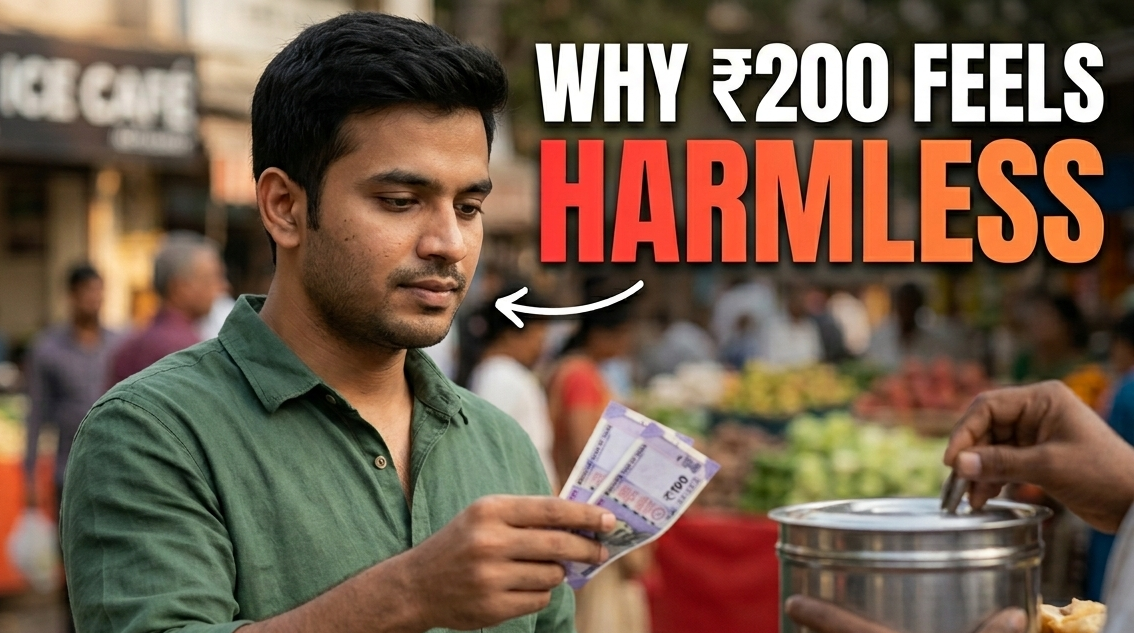
You spent ₹200 today. It felt like nothing.
You’ll probably spend ₹200 again tomorrow. And the day after.
That’s where the real story begins.
Why Small Daily Expenses Feel So Harmless
There is a reason ₹200 never feels like a financial decision. It is because, in the moment, it genuinely isn’t one. A cup of coffee, a quick snack, a small top-up, a cheap impulse buy at the checkout counter — none of these trigger the part of your brain that handles serious choices. They are too small to feel significant. And that is precisely what makes them dangerous over time.
This is not a personal failure. It is psychology.
The human brain is wired to evaluate decisions based on immediate impact. A ₹200 purchase does not change your life today. It does not empty your account. It does not cause any visible harm. So your brain files it under “harmless” and moves on. The problem is that your brain does this every single day, for every small purchase, without ever adding them together.
Psychologists call this denomination effect — the tendency to treat smaller currency units as less valuable and therefore easier to spend. A ₹200 note feels like a throwaway amount. A ₹6,000 monthly total feels very different. But they are the same thing.
Small expenses add up daily in ways our minds are simply not designed to track naturally. The gap between how harmless each purchase feels and how significant they become collectively is where most people’s money quietly disappears.
Why This Problem Has Gotten Worse Over Time
This is not a new human tendency. People have always underestimated small spending. But several things about modern life have made it significantly worse.
Digital payments removed the pain of spending. When you tap your phone or card, there is no physical exchange. No wallet opening. No notes counted. No coins handed over. Research in behavioral economics consistently shows that people spend more when using digital payments compared to cash, simply because the friction is gone. ₹200 on UPI feels even less real than ₹200 in notes.
Small purchases are now available everywhere, all the time. Food delivery at midnight. A quick online order during a lunch break. An in-app purchase while watching something. The access to small spending has expanded enormously. Every new convenience is also a new opportunity for small expenses to add up.
Micro-transactions are designed to feel trivial. Platforms and businesses have deliberately broken down pricing into small units precisely because small numbers feel easier to say yes to. ₹29 per day sounds nothing like ₹870 per month. The math is identical. The psychology is not.
The environment around daily spending habits has been engineered to make small expenses feel consequence-free. Understanding that is the first step to seeing through it.
What Most People Misunderstand About Small Purchases
The most common response when people first realize their small expenses add up is guilt. They look back at months of ₹200 purchases and feel like they made a series of bad decisions. That framing is not only inaccurate — it is unhelpful.
Here is what most people get wrong.
Small Spending Is Not the Enemy
The problem is not that you bought a coffee or ordered a snack. Some of those purchases genuinely added value to your day. The problem is not the individual decision. The problem is the absence of awareness around the pattern.
There is a significant difference between consciously choosing to spend ₹200 on something that gives you real value, and spending ₹200 on something you barely remember an hour later. Both look identical on a bank statement. Only one was a genuine choice.
People Underestimate Frequency, Not Amount
When most people try to calculate their small spending, they think about single instances. “I only order coffee a couple of times a week.” But memory is unreliable for frequency. Studies on spending recall show that people consistently underestimate how often they make small purchases by a significant margin.
The brain remembers the occasional big purchase clearly. It blurs together the many small ones. So when you try to mentally estimate your daily spending habits, you are almost always working with a number that is too low.
The “I Deserve It” Justification
One of the most common psychological patterns around small daily spending is the reward justification. A hard day at work, a stressful commute, a difficult meeting — and suddenly a small purchase feels earned. “I deserve this.” This is not irrational. Treating yourself is a legitimate human need.
But the reward justification tends to activate very easily and very frequently. Over time, almost any minor discomfort can qualify as a reason to spend. When that happens, small expenses are no longer occasional rewards. They are a default coping pattern. And the amounts add up whether the reward was genuine or reflexive.
A Real-Life Example Worth Sitting With
Consider a young working professional in a mid-sized Indian city. She earns a stable salary and considers herself reasonably careful with money. She doesn’t make big impulsive purchases. But she does order one coffee most mornings, gets food delivered three or four times a week, buys a small snack from the office canteen daily, and occasionally picks up something small while scrolling late at night.
None of it felt like spending. All of it felt like just living.
When she actually tracked these purchases for a single month, the total crossed ₹8,000. That was more than she had allocated for entertainment and personal care combined. The shock was not the amount — it was that she had genuinely believed she was spending almost nothing on these things.
This is not an unusual story. It is the default experience for most people who have never tracked their small daily expenses.
What Actually Happens in the Brain During Small Purchases
Understanding the psychology behind this pattern makes it easier to work with rather than against.
The Pain of Paying
Behavioral economists have identified something called the “pain of paying” — a mild discomfort that occurs when we spend money. This pain serves as a natural brake on spending. But the pain of paying is significantly lower for small amounts than for large ones. It is also lower for digital payments than for cash.
This means the natural psychological brake that prevents overspending barely activates for ₹200 purchases made on UPI. The system that is supposed to make you pause simply doesn’t engage.
Present Bias
The human brain consistently overvalues the present moment compared to the future. A small pleasure right now feels more real than the abstract benefit of having saved that money a year from now. This is not laziness or poor character. It is how human cognition is structured.
Present bias is why daily spending habits are so hard to change through willpower alone. You are asking your brain to choose a future benefit it cannot feel over a present pleasure it can. That is a structurally unequal contest.
The Numbness Effect
When small expenses add up daily over a long period, something else happens. The spending becomes invisible. You stop noticing it the way you stop noticing background noise. ₹200 here and there becomes part of the texture of daily life, no longer even registered as a decision.
This numbness is perhaps the most significant psychological barrier. You cannot manage what you no longer see.
How Awareness Around Small Expenses Actually Works
This section is not about cutting spending or following a strict plan. It is about what genuine awareness looks like in practice, and why it works differently from what most people try.
Tracking Changes Perception, Not Just Numbers
When people begin tracking their small daily expenses — even casually, even imperfectly — something shifts. The act of recording a purchase, however briefly, reintroduces a moment of pause. It reactivates a mild version of the pain of paying. It reconnects the present decision to the larger pattern.
This is not about punishment or restriction. It is about giving your brain the information it needs to make a real choice rather than an automatic one.
Weekly Visibility Is More Effective Than Monthly Regret
Most people review their finances at the end of the month, when the damage is already done. A brief weekly look at small purchases is significantly more useful. It keeps the pattern visible in real time. It also makes the connection between daily spending habits and monthly totals easier to see.
When you can see that three days of small purchases already added up to ₹1,400, the remaining weeks of the month feel different. You are not cutting back. You are simply staying aware.
Categorize Small Purchases Honestly
Not all small spending is equal. Some of it genuinely adds value — a meal that saved time on a difficult day, a small purchase that brought real enjoyment. Some of it is habitual, reflexive, or barely remembered.
When you categorize small expenses honestly, you begin to see the difference. The goal is not to eliminate spending. It is to understand which small purchases you would consciously choose again and which ones simply happened without a real decision being made.
That distinction, applied consistently, is where daily spending habits begin to shift naturally.
The Subheading Your Budget Is Missing: Small Expenses Add Up Silently
Most personal finance conversations focus on the big categories. Housing. Transport. Major purchases. These are important. But they are also visible. You know what your rent is. You know what your EMI costs.
What most budgets completely miss is the cumulative weight of small expenses that add up daily across dozens of micro-decisions. These don’t appear as a single line item. They are scattered across food, convenience, entertainment, and miscellaneous. They look small individually. Together, they often represent one of the largest spending categories in a middle-class household.
The budget that ignores small daily spending is working with incomplete information. And incomplete information leads to the same confusion every month — the salary is gone, and no one is quite sure where it went.
Clear Takeaway: You Are Not Careless. You Are Just Unaware.
The psychology of small daily spending is not a story about bad habits or weak willpower. It is a story about a mismatch between how the human brain processes small decisions and how those decisions accumulate over time.
Small expenses add up daily in ways that feel invisible because they are designed to feel invisible. The denomination effect, present bias, the reduced pain of digital payments, and the numbness that comes from repetition — all of these work together to make ₹200 feel like nothing, over and over again, until the month is gone.
The starting point is not a stricter budget. It is honest visibility. Look at what you actually spent last month on small purchases. Not to judge it. Just to see it clearly.
That single act of looking — calmly, without guilt — is the beginning of a genuinely different relationship with daily spending.
A Final Thought on Patience and Long-Term Thinking
Changing your awareness around small daily expenses is not something that happens in a week. It takes time to retrain your perception. It takes a few months of tracking before the patterns become clear. It takes patience with yourself when you slip back into automatic spending.
But the shift, when it comes, is quiet and lasting. You don’t suddenly become a different person. You just start noticing things you didn’t notice before. A purchase you would have made automatically now gets a half-second of consideration. Sometimes you still make it. Sometimes you don’t. Either way, it was a choice.
That is the difference. Not perfection. Not restriction. Just the return of conscious decision-making to the small moments that quietly shape your financial life every single day.
₹200 is not harmless. But it is also not the enemy. Awareness is the only thing that makes the difference between the two. FOLLOW FOR MORE…