There’s a moment—usually around 2 AM in a hospital waiting room, or right after the fender bender, or the day the diagnosis comes back—when it hits you: “I should have done this sooner.”
By then, it’s already too late.
The Text Message That Changes Everything
Sarah was 32 when her phone buzzed at work.
“Dad’s in the ER. Heart attack. Come now.”
She made it to the hospital in seventeen minutes. Her father survived, but the bills didn’t care about happy endings. $47,000 for a three-day stay. Her parents had been “meaning to get better health insurance” for years. They were healthy. Why pay for something you don’t use?
Now they were selling the car to pay off medical debt.
Sarah bought life insurance the following week. Not because she suddenly understood actuarial tables or policy riders. Because she’d seen, firsthand, how one unexpected moment can financially devastate a family.
Most of us are Sarah before that text message.
We’re not stupid. We’re not careless. We’re just operating under a comforting illusion: bad things happen to other people.
Until they don’t.
The Uncomfortable Math Nobody Wants to Do
Here’s a question that makes people squirm: What would happen to your family if you died tomorrow?
Not “if you got sick” or “if you had an accident.” Dead. Gone. No more paychecks.
Could your spouse pay the mortgage? Would your kids still go to college? Would your parents have to cover your funeral costs while grieving?
Most people genuinely don’t know the answer. And because they don’t know, they don’t act.
We avoid thinking about our own mortality the same way we avoid thinking about our browser history—it’s uncomfortable, so we just… don’t.
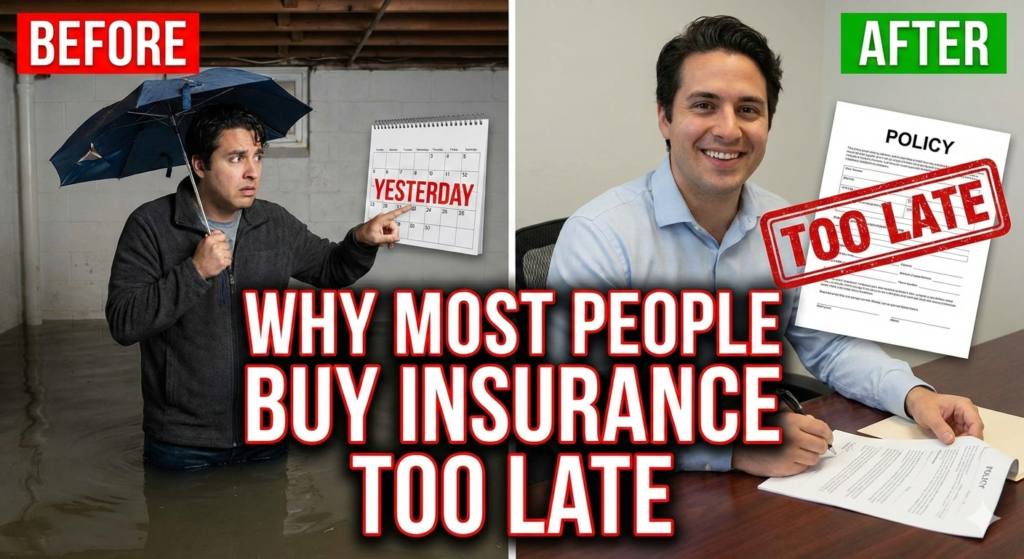
But here’s the thing about insurance: it only works if you get it before you need it.
That’s not some corporate catchphrase. That’s the fundamental reality of how risk pooling works. Insurance companies will happily sell you flood insurance—until your neighborhood starts flooding. They’ll cover your health—until you get diagnosed with something expensive.
The entire system is built on insuring people before they become expensive to insure.
Which means the moment you realize you need it is often the moment you can no longer get it. Or at least, not at a price you can afford.
The Three Lies We Tell Ourselves
Lie #1: “I’m Young and Healthy”
Congratulations. That’s precisely when you should buy insurance—when you’re the cheapest to insure.
A healthy 25-year-old can get a $500,000 term life insurance policy for about $20-30 a month. That same person at 45, after developing high blood pressure or diabetes? Now it’s $100+ per month. At 55 with a heart condition? Good luck getting approved at all.
Youth isn’t a reason to skip insurance. It’s the golden window when insurance is most affordable and accessible.
But we treat it backwards. We wait until we’re older, sicker, and more expensive to insure, then complain about the premiums.
Lie #2: “I Don’t Have Anyone Depending on Me”
Really? No parents who might have to pay for your funeral? No student loans with a co-signer? No credit card debt that won’t just disappear when you do?
Even if you’re genuinely solo, disability insurance matters. Because if you can’t work, how exactly do you plan to pay rent? Your landlord doesn’t accept “I’m temporarily unable to earn money” as payment.
Sixty percent of bankruptcies involve medical debt. You know what those people had in common? They thought they didn’t need insurance either.
Lie #3: “I’ll Get It Later When I Really Need It”
This is the fatal one. The one that ruins families.
Insurance isn’t something you buy when you need it. That’s not how any of this works. You buy insurance when you don’t need it, so it’s there when you do.
It’s like saying “I’ll install smoke detectors after the fire starts.” Technically you could, but you’ve sort of missed the point.
The Actual Reason We Wait (And It’s Not What You Think)
Cost? That’s what we tell ourselves. But people spend $200/month on streaming services, food delivery, and fancy coffee without blinking.
The real reason is psychological: insurance forces us to confront our own vulnerability.
Buying life insurance means admitting you could die. Buying disability insurance means imagining yourself unable to work. Health insurance means acknowledging your body will eventually fail.
We are spectacularly bad at imagining future versions of ourselves, especially suffering future versions. Our brains are wired for optimism bias—the belief that bad things are more likely to happen to others than to us.
It’s why we text and drive. Why we skip sunscreen. Why we eat that third donut.
And why we put off insurance until it’s too late.
We’re not being irresponsible. We’re being human. Our brains literally protect us from existential dread by convincing us we’re somehow special, somehow exempt from statistics.
Except we’re not.
The Stories You Don’t Hear Until It’s Too Late
The Entrepreneur:
Mark quit his corporate job at 34 to start his own business. He was healthy, energetic, brilliant. Health insurance through the marketplace was expensive, so he went without for “just a few months” while he got established.
Month three, he noticed some unusual fatigue. Month four, the diagnosis: leukemia.
Treatment cost: $400,000+
His savings: $50,000
His GoFundMe page raised $30,000. The rest? Medical debt that followed him for a decade. His business never launched. He spent his 30s fighting cancer and fighting bankruptcy simultaneously.
The New Parents:
Jessica and Tom had their first baby and meant to update their life insurance. They’d get to it. They were busy with diapers and sleep deprivation and figuring out this whole parenting thing.
Tom died in a car accident when their daughter was fourteen months old.
Jessica discovered he had a small policy from his employer—$50,000. After funeral costs, it left about $35,000. That’s it. That’s what she had to raise a child alone, cover the mortgage, and rebuild her life.
She went back to work three weeks after burying her husband because she had no choice.
The “It Won’t Happen to Me” Guy:
Brian was 28, a CrossFit enthusiast, ate clean, didn’t smoke. He figured disability insurance was for old people or people with risky jobs. He worked in marketing from a desk.
Then he got hit by a distracted driver on his bike commute. Spinal injury. Permanent partial disability. He could work, but not at his previous capacity. His income dropped by 60%.
No disability insurance meant no safety net. He moved back in with his parents at 29 and spent two years retraining for a job he could physically handle.
These aren’t cautionary tales designed to scare you. These are Tuesday afternoons in America. They happen constantly, to people who never thought they’d be “that person.”
The Cost of Waiting (Let’s Do the Actual Math)
Here’s what waiting costs in real dollars:
Life Insurance:
- 25-year-old: $20/month for $500k coverage
- 35-year-old: $35/month for same coverage
- 45-year-old: $80/month for same coverage
Wait 20 years? You’re paying 4x more for the exact same protection. Over a 30-year term, that’s a difference of $21,600.
Health Insurance:
Going uninsured to “save money”? A single emergency room visit for something minor like a broken bone: $2,500-$10,000. A serious accident or illness? You’re looking at bankruptcy.
The average premium for marketplace insurance might be $400-600/month for a family. Sounds expensive until you realize a single hospital stay can cost more than you’d pay in premiums over five years.
Disability Insurance:
The average long-term disability lasts 34.6 months. If you earn $50,000/year and become disabled without coverage, you’re looking at losing $144,000+ in income.
A disability policy might cost $50-150/month. That’s $1,800/year to protect against a six-figure loss.
The math isn’t complicated. We just don’t do it until we’re forced to.
What Nobody Tells You About “Pre-Existing Conditions”
Here’s the nightmare scenario: you finally decide to get insurance. You fill out the application honestly.
Denied.
Or worse—approved with exclusions. “We’ll cover you for everything except the thing you’re most likely to need coverage for.”
That back pain you saw a doctor about two years ago? Pre-existing condition. Your anxiety medication? Pre-existing condition. The high cholesterol you’re managing with diet and exercise? You guessed it.
Health insurance has some protections thanks to the Affordable Care Act (for now), but life insurance and disability insurance absolutely discriminate based on your medical history.
And they should. That’s how risk pooling works. But it means the window to get affordable, comprehensive coverage is narrower than you think.
Every doctor’s visit, every diagnosis, every prescription gets noted in your medical records. And insurance companies will see all of it when you apply.
The time to get insurance isn’t after you know you need it. It’s before your medical history becomes a liability.
The Types of Insurance You’re Probably Ignoring (Ranked by Regret)
#1: Disability Insurance (The Most Overlooked)
You’re three times more likely to become disabled than to die during your working years. Three times.
Yet most people have life insurance but no disability coverage. We’re literally more worried about dying than about being unable to work, even though the latter is far more likely and financially devastating.
If you can work, you can earn. If you can’t work? Everything falls apart fast.
#2: Life Insurance (If Anyone Depends on Your Income)
Not your employer’s basic policy. That’s usually only 1-2x your salary and disappears when you leave the job.
Actual term life insurance that would replace your income for years if you died unexpectedly.
Rule of thumb: 10-12x your annual income. If you make $60,000, you should have $600,000-720,000 in coverage. Sounds like a lot until you realize it’s meant to replace decades of income.
#3: Umbrella Insurance (The “Lawsuit Protection” Nobody Thinks About)
You rear-end someone. They’re seriously injured. They sue you for $800,000.
Your auto insurance covers $250,000.
Where does the other $550,000 come from? Your house. Your savings. Your future wages.
An umbrella policy covering $1-2 million costs about $200-400/year and protects everything you own.
Nobody thinks about this until they’re being sued.
#4: Long-Term Care Insurance (The One Your Parents Need)
Nursing homes cost $7,000-10,000 per month. Most people need care for 2-4 years. That’s $168,000-480,000.
Medicare doesn’t cover long-term care. Your savings probably can’t either.
This is the insurance that determines whether you die with dignity or die broke.
The Psychology Trick That Actually Works
Here’s what changed my mind about insurance, and it might work for you too:
Stop thinking of insurance as something you buy for yourself. You’re buying it for the people you love.
When I framed life insurance as “do I want to live forever?” I kept putting it off. When I reframed it as “do I want my wife to lose our house if I die?” I bought a policy within a week.
Disability insurance? Not about me being invincible. It’s about not wanting my family to lose everything if I get sick.
We’re weirdly more motivated to protect others than to protect ourselves. Use that.
You might not care about future-you. But you probably care about your spouse not drowning in debt, or your kids not having to drop out of school, or your parents not having to raid their retirement to bury you.
Buy insurance for them.
The “I’ll Do It Tomorrow” Tax
Every day you wait is a day older you get. A day closer to a potential diagnosis. A day more expensive insurance becomes.
The absolute best time to buy insurance was ten years ago.
The second-best time is today.
Not when you “have more money.” Not when you “understand it better.” Not after you “do more research.”
Today. While you’re healthy. While you’re insurable. While it’s affordable.
Because tomorrow you might wake up with symptoms. Next month you might get a diagnosis. Next year you might be uninsurable.
The “I’ll do it later” tax is paid in declined applications, excluded conditions, and astronomical premiums.
What to Actually Do (The Non-Overwhelming Version)
Step 1: Get a term life insurance quote. Takes 10 minutes online. You don’t have to buy it, just see what it actually costs. You’ll probably be surprised how affordable it is.
Step 2: Check if your employer offers disability insurance. Many do, and it’s usually cheaper through group rates. If they don’t, get a quote independently.
Step 3: Review your health insurance. If you’re uninsured or underinsured, go to healthcare.gov and see what’s available. Even a high-deductible plan is better than nothing.
Step 4: Talk to an insurance agent. Yes, they’re salespeople. They also know what you actually need versus what you think you need. Get multiple quotes.
Step 5: Buy something. Not the perfect policy. Not the cheapest policy. Just a policy. You can always adjust later. The key is getting covered.
Waiting for perfect information is just procrastination in disguise.
The Question That Should Keep You Up at Night
If something happened to you tomorrow—death, disability, serious illness—what would happen to the people who depend on you?
Sit with that question. Really sit with it.
Not in a morbid way. In a pragmatic, adult, “I’m responsible for other humans” way.
If your answer is “they’d be fine,” great. You’re either independently wealthy or already properly insured.
If your answer is anything else—”they’d struggle,” “they’d have to sell the house,” “I honestly don’t know”—then you already know what you need to do.
The Uncomfortable Truth We’re All Avoiding
Insurance is a bet you hope to lose.
You pay premiums for years, hopefully decades, and pray you never need to use it. That feels wasteful. It feels like throwing money away.
Until the day you need it.
And then it’s the best money you ever spent.
Every person I know who’s had to use their insurance—who’s filed a life insurance claim after losing a spouse, who’s collected disability after an accident, who’s had cancer treatment covered by health insurance—every single one says the same thing:
“Thank God I had it. I don’t know what we would have done.”
Nobody ever says “I wish I’d waited longer to get insurance.”
Nobody.
The Bottom Line
You’re going to buy insurance eventually. Everyone does. Life has a way of forcing the issue.
The only question is whether you buy it while you’re healthy and it’s affordable, or whether you wait until you’re sick and it’s expensive (or impossible).
Most people wait. They wait until the heart attack, the accident, the diagnosis, the lawsuit.
And then they spend the rest of their lives wishing they hadn’t.
Don’t be most people.
Insurance isn’t about planning to die. It’s about planning to live—and making sure the people you love can keep living too, even if you can’t.
What’s holding you back from getting insured? And is it really worth the risk? FOLLOW FOR MORE…