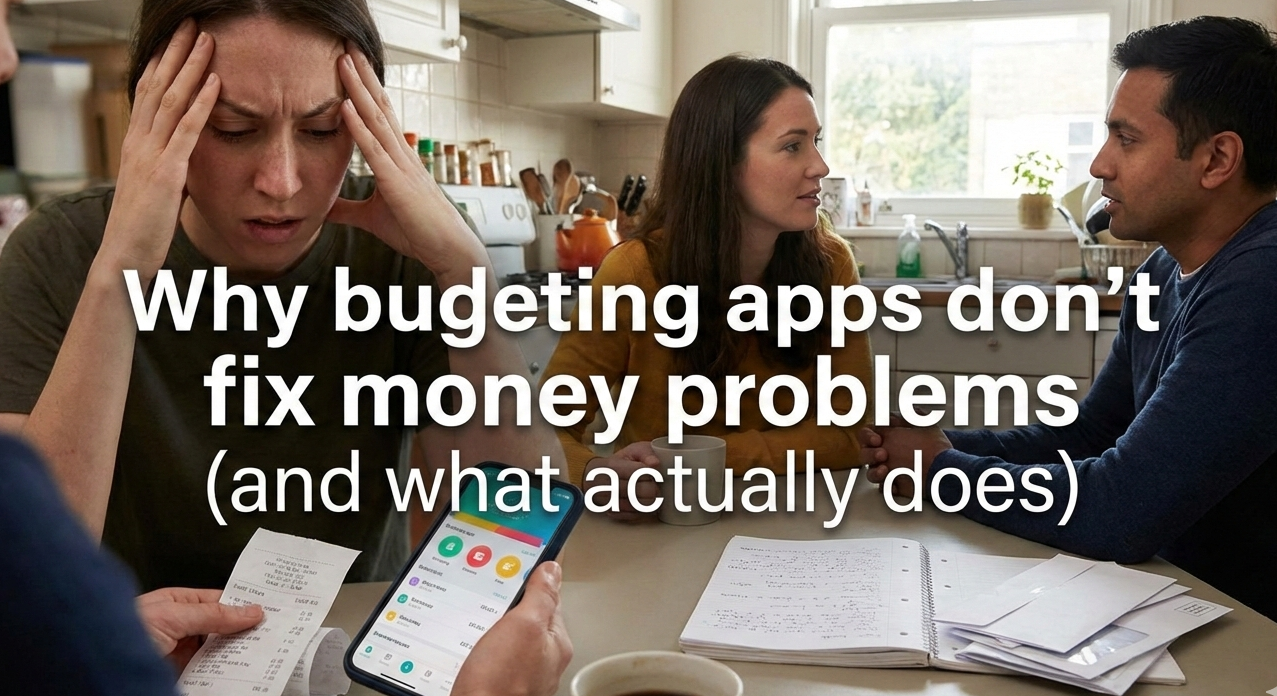
Budgeting apps promise control, clarity, and better money habits, yet many people still struggle with the same financial problems month after month.
You download a budgeting app with good intentions.
You connect your bank account, categorise expenses, and promise yourself that this time things will be different.
For a few weeks, you feel in control.
Then life happens.
Bills arrive. EMIs don’t pause. Expenses repeat.
And slowly, the app becomes something you stop opening—not because it failed technically, but because it didn’t change how money feels.
So the real question is:
If budgeting apps are so smart, why do money problems still feel the same?
The Comfort of Seeing Everything (Without Changing Anything)
Budgeting apps are excellent at one thing: showing reality.
They tell you:
- Where your money went
- How much you overspent
- Which category crossed the limit
But knowing isn’t the same as fixing.
For many people, budgeting apps become a monthly reminder of pressure rather than a source of relief. You don’t discover anything new—you just see the same story, neatly organised.
Awareness increases. Stress stays.
Why Tracking Feels Helpful but Rarely Feels Liberating
Most people already know their problem isn’t coffee or food delivery.
It’s:
- Rent or home loans
- EMIs that don’t shrink
- Fixed monthly obligations
- Costs that rise faster than income
No app can “optimize” money that’s already committed.
That’s why budgeting often feels like restriction instead of progress. You’re asked to control the few flexible expenses while the biggest ones remain untouched.
The Emotional Problem Budgeting Apps Can’t Solve
Money stress is not just about numbers; it’s about emotions. Budgeting apps track spending but don’t reduce anxiety or pressure. When money already feels tight, constant monitoring can increase guilt instead of relief. Over time, people disengage not from carelessness, but from emotional exhaustion.
Money problems are rarely just mathematical.
They’re emotional.
Budgeting apps focus on discipline:
- Stay under limits
- Avoid overspending
- Correct behaviour
But when money already feels tight, discipline feels like punishment.
Over time, people don’t quit budgeting because they’re careless.
They quit because constant monitoring without relief is exhausting.
The Real Mistake: Expecting Tools to Create Change
Budgeting apps are tools—not solutions.
They work like a health report.
Useful, accurate, and informative—but they don’t improve health on their own.
Expecting a budgeting app to fix money problems is like expecting a weighing scale to cause weight loss.
The tool isn’t the issue.
The expectation is.
What Actually Helps (And It’s Surprisingly Simple)
Real financial relief comes from reducing pressure, not tracking it better.
What actually works for most people:
- Creating breathing room before optimizing spending
- Questioning fixed expenses, not just daily ones
- Avoiding automatic lifestyle upgrades
- Choosing one clear financial priority instead of ten rules
When pressure reduces, budgeting becomes easier—sometimes unnecessary.
Why Simpler Systems Work Better Than Perfect Budgets
People who improve their finances long-term rarely manage every rupee.
They rely on:
- One savings habit
- One spending boundary
- One clear goal
Simplicity removes daily decision-making.
Less tracking. Less guilt. More consistency.
Where Budgeting Apps Do Help (When Used Right)
Budgeting apps aren’t useless.
They help when:
- Used as a review tool, not a control system
- Checked occasionally, not obsessively
- Paired with structural changes, not willpower
When pressure is lower, apps support clarity instead of stress.
The Real Takeaway
Budgeting apps don’t fail because they’re bad.
They fail because money problems aren’t created by poor tracking alone.
Until financial pressure reduces, no app can create peace.
Money improves when life becomes manageable—not when spreadsheets become perfect.
Final thought
You don’t need a smarter app.
You need less pressure and clearer priorities.
Everything else becomes easier after that. FOLLOW FOR MORE CONTENTS….