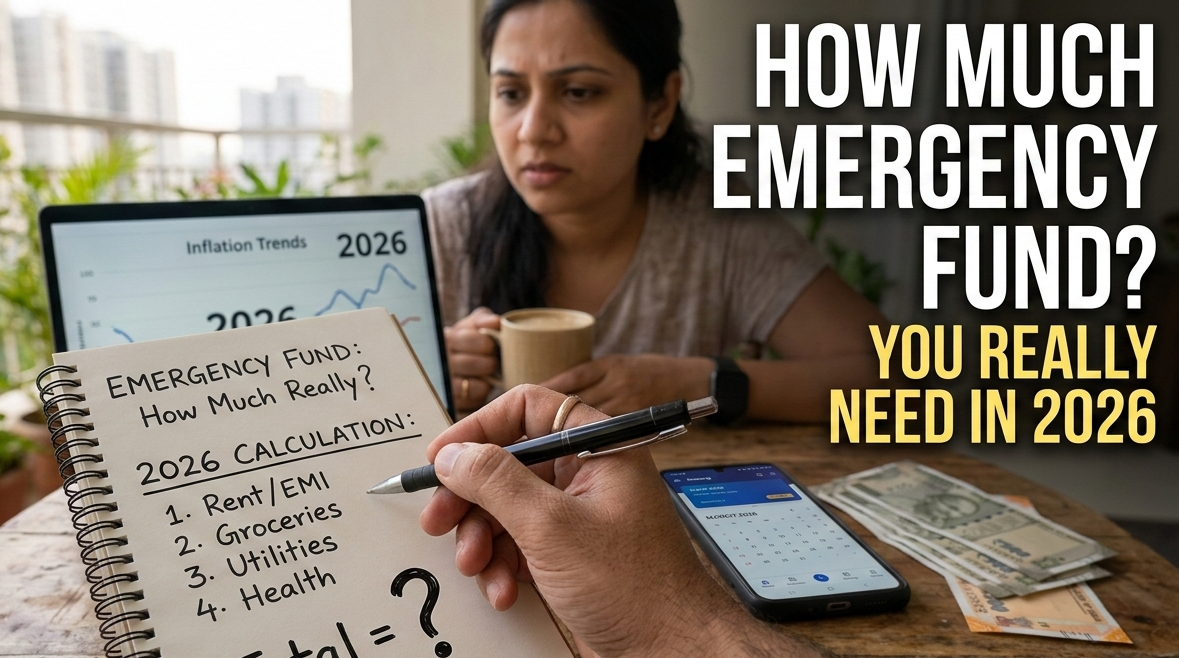
Most people know they should have an emergency fund.
Very few know how much is actually enough.
And almost nobody has sat down to calculate the right emergency fund amount in India for their specific life — their income, their expenses, their dependents, and their actual financial risks.
Why the Emergency Fund Conversation Is Still Incomplete in India
The concept of an emergency fund is not new. Financial advisors have recommended it for decades. The standard guidance — save three to six months of expenses — has been repeated so often it has become background noise. People hear it, nod, and move on without ever calculating what three to six months actually means for their specific household.
This is the first problem. Generic guidance without personal calculation is not useful. Three months of expenses for a single professional in a tier-two city with no dependents is a completely different number from three months of expenses for a family of four in Mumbai with a home loan, school fees, and ageing parents.
The second problem is that the conversation around emergency fund amount in India rarely accounts for the specific financial vulnerabilities that Indian middle-class households carry. Job market volatility. Single-income households. Medical expenses for extended family. Informal financial obligations that cannot be postponed. These are real and common risks that generic Western emergency fund advice was never designed to address.
The result is that most Indian households either have no emergency fund at all, or have one that is too small to be genuinely useful when a real emergency arrives.
What Counts as a Financial Emergency — and What Does Not
Before calculating how much to save, it helps to be clear about what an emergency fund is actually for. This clarity matters more than most people realize, because vague definitions lead to emergency funds that get used for the wrong things and are not there when the right thing happens.
A genuine financial emergency is an unexpected, unavoidable expense that threatens your ability to meet essential obligations. Job loss. A significant medical expense not covered by insurance. A major home repair that cannot be deferred. A family crisis that requires immediate financial support.
What an emergency fund is not for — a planned purchase, a vacation, an annual expense that was predictable, a sale that felt too good to miss, or a short-term cash flow problem caused by poor budgeting.
The distinction matters because many people dip into their emergency savings for semi-discretionary reasons, then find the fund genuinely depleted when a real emergency arrives. Defining the boundaries of what qualifies as an emergency, before one occurs, is part of building a fund that actually functions as intended.
The Standard Advice and Why It Needs Updating for 2026
The three-to-six months guidance has been the default recommendation for emergency savings for a long time. It is not wrong. But in 2026, the Indian financial landscape has specific characteristics that make a more nuanced calculation more useful.
The Job Market Has Changed
The nature of employment in India has shifted significantly. Contractual roles, project-based work, gig economy participation, and startup employment have all grown. These employment forms typically come with less job security and less predictable income than traditional permanent employment.
For someone in a stable government job with strong tenure protection, three months of expenses may be a reasonable floor. For someone in a startup, a contractual role, or a commission-based position, that number is likely insufficient. The time to find new employment in specialized or competitive fields has also grown, meaning the period of income disruption after a job loss can easily exceed three months in the current environment.
Medical Costs Have Risen Sharply
Healthcare inflation in India has consistently outpaced general inflation. Even for households with health insurance, out-of-pocket costs — deductibles, non-covered treatments, consumables, post-hospitalization care — have grown substantially. An emergency fund that was adequate for medical contingencies three years ago may no longer be sufficient today.
Family Financial Obligations Are Real and Recurring
For a large portion of Indian middle-class households, financial emergencies are not limited to their own household. An ageing parent’s medical expense. A sibling’s financial crisis. A family obligation that arrives without warning and cannot be declined. These are genuine financial risks that most emergency fund calculations completely ignore.
If these obligations are a real part of your financial life — and for most Indian families they are — your emergency fund calculation needs to account for them honestly.
What Most People Misunderstand About Emergency Fund Amount in India
The Calculation Should Be Based on Expenses, Not Income
Most people, when they think about their emergency fund, anchor it to their income. “I earn ₹60,000 a month, so six months would be ₹3,60,000.” This seems logical but it is the wrong starting point.
The correct base for emergency fund calculation is your essential monthly expenses — not your income. Your emergency fund needs to cover what you must pay, not what you earn. Rent, EMIs, groceries, utilities, school fees, insurance premiums, and essential transport. These are the obligations that cannot stop even when income does.
For many households, essential monthly expenses are significantly lower than monthly income. Using income as the base leads to a larger target that feels unachievable, when a smaller and more accurate expense-based target is both more correct and more motivating to build toward.
The Right Number Depends on Your Specific Risk Profile
The three-to-six month range is a starting range, not a fixed answer. Within that range, your position should be determined by your specific circumstances.
Factors that push toward a larger emergency fund — a single income household, variable or unstable income, dependents including children or ageing parents, significant EMI obligations, inadequate health insurance, employment in a volatile sector, or limited family support network.
Factors that allow for a smaller emergency fund — dual income household with both incomes stable, strong employer-provided health insurance, low EMI burden, robust family financial support available, employment in a highly stable sector with strong job security.
Mapping your own situation honestly against these factors produces a more accurate target than any generic recommendation.
An Emergency Fund Sitting in a Savings Account May Be Losing Value
This is a 2026-specific consideration. With inflation running at meaningful levels, money sitting idle in a regular savings account earning low interest is losing purchasing power over time. Your emergency corpus needs to be liquid — accessible within a day or two — but it does not have to earn nothing while it waits.
Liquid funds, short-duration debt instruments, and high-yield savings options exist in India today that offer better returns than standard savings accounts without sacrificing meaningful liquidity. The specific options available change over time, but the principle is consistent — your emergency fund should be both accessible and working as hard as it reasonably can without taking on risk that compromises its availability.
A Real-Life Example Worth Considering
Consider a married couple in Bengaluru, both working, with one young child and a home loan. Their combined take-home is ₹1,40,000 per month. Their essential monthly expenses — EMI, rent, groceries, school fees, utilities, insurance premiums — total ₹85,000.
When they calculated their emergency fund target based on income, the number felt enormous and distant. When they recalculated based on essential expenses, the target became ₹5,10,000 for six months — still significant, but a number they could build toward in a structured way. They also identified that their single health insurance policy had significant coverage gaps for critical illness, which meant their medical emergency risk was higher than they had assumed. They adjusted their target upward to seven months as a result.
The calculation, done properly, gave them a specific and honest number. That specificity made the goal real in a way that “three to six months” never had.
How to Actually Calculate Your Emergency Fund Amount in India
This is not a complex process. It requires honesty more than mathematics.
Step One — List Every Essential Monthly Expense
Write down every expense that must be paid regardless of what happens to your income. Rent or home loan EMI. Other loan EMIs. Grocery and household supplies. School or education fees. Utility bills. Health and life insurance premiums. Essential transport costs. Any fixed family financial obligations.
Do not include discretionary spending — dining out, entertainment, subscriptions, clothing, travel. These can be reduced or eliminated in a genuine financial emergency. Your essential expense number should reflect the minimum your household genuinely needs to function.
Step Two — Multiply by Your Target Months
Once you have your essential monthly expense figure, multiply it by the number of months appropriate to your risk profile. Use the factors described above to determine where in the range — or slightly above it — you should sit.
A reasonable starting framework for Indian middle-class households in 2026 looks something like this. Three to four months for dual-income stable households with strong insurance and low EMI burden. Five to six months for single-income households, households with significant EMI obligations, or anyone in variable income employment. Six to nine months for households with ageing dependents, high medical risk, inadequate insurance coverage, or employment in volatile sectors.
Step Three — Add a Medical Buffer Separately
Given healthcare cost inflation in India, many financial planners now recommend treating medical emergency reserves as a separate component alongside the standard expense-based fund. A dedicated medical buffer of ₹1,00,000 to ₹2,00,000, separate from your main emergency corpus, provides an additional layer of protection specifically for health-related emergencies that your insurance may not fully cover.
This is not a rigid rule. It is a recognition that medical expenses are among the most common and most financially disruptive emergencies Indian households face, and they deserve specific consideration in your emergency planning.
Step Four — Build It Gradually and Protect It Deliberately
Very few people can build a full emergency fund immediately. That is not the goal. The goal is to start building it systematically and to protect it once built.
A consistent monthly contribution — even a modest one — directed specifically toward your emergency corpus, separated from your regular savings and spending, will build the fund over time. Twelve to eighteen months of consistent contribution is a realistic timeline for most middle-class Indian households to reach their target.
Once built, the fund needs protection. That means not dipping into it for non-emergency purposes and replenishing it promptly if it is ever used.
The Subheading That Matters: Emergency Fund Amount in India Is Personal, Not Generic
The most important shift in thinking about emergency savings is moving from a generic number to a personal one. The right emergency fund amount in India for your household is built from your essential expenses, your income stability, your dependents, your insurance coverage, and your specific financial obligations.
No article, no advisor, and no rule of thumb can give you that number without knowing your life. What any useful framework can do — and what this one attempts — is give you the structure to calculate it yourself, honestly, based on what your life actually looks like in 2026.
That personal number, once you have it, changes how you think about building toward it. It is no longer an abstract concept. It is a specific target with a specific meaning — the amount of time your household can survive financially, at its essential level, without any income coming in.
That number is worth knowing. And worth building toward.
Clear Takeaway: The Right Emergency Fund Is Specific, Not Standard
The emergency fund amount in India that makes sense for your household in 2026 is not three months. It is not six months. It is the number you arrive at when you honestly assess your essential expenses, your income stability, your dependents, your insurance gaps, and your specific financial risks.
For some households that number will be four months of expenses. For others it will be eight. Both can be correct — for different lives, in different circumstances, carrying different risks.
The starting point is always your essential monthly expense figure. Everything else is built from there. And the most important step is simply beginning — calculating the number, making it specific, and building toward it consistently.
A fund you never finish building is still more protection than one you never start.
A Final Thought on Security and the Long View
An emergency fund is not an exciting financial goal. It does not grow dramatically. It does not feel like progress the way an investment portfolio does. It just sits there, waiting for something that you hope never happens.
That is exactly what makes it valuable.
The households that navigate financial shocks most successfully — job losses, medical crises, unexpected large expenses — are almost always the ones that had a genuine financial cushion in place before the shock arrived. Not because they were wealthier. But because they had prepared for the possibility that things might not go smoothly.
Building your emergency fund is an act of financial self-respect. It is acknowledging that life is unpredictable, that emergencies are not hypothetical, and that the people who depend on you deserve the security of knowing that one bad month — or several bad months — will not unravel everything you have built.
That security, quiet and invisible until the moment it is needed, is one of the most genuinely valuable things you can build in your financial life. FOLLOW FOR MORE…