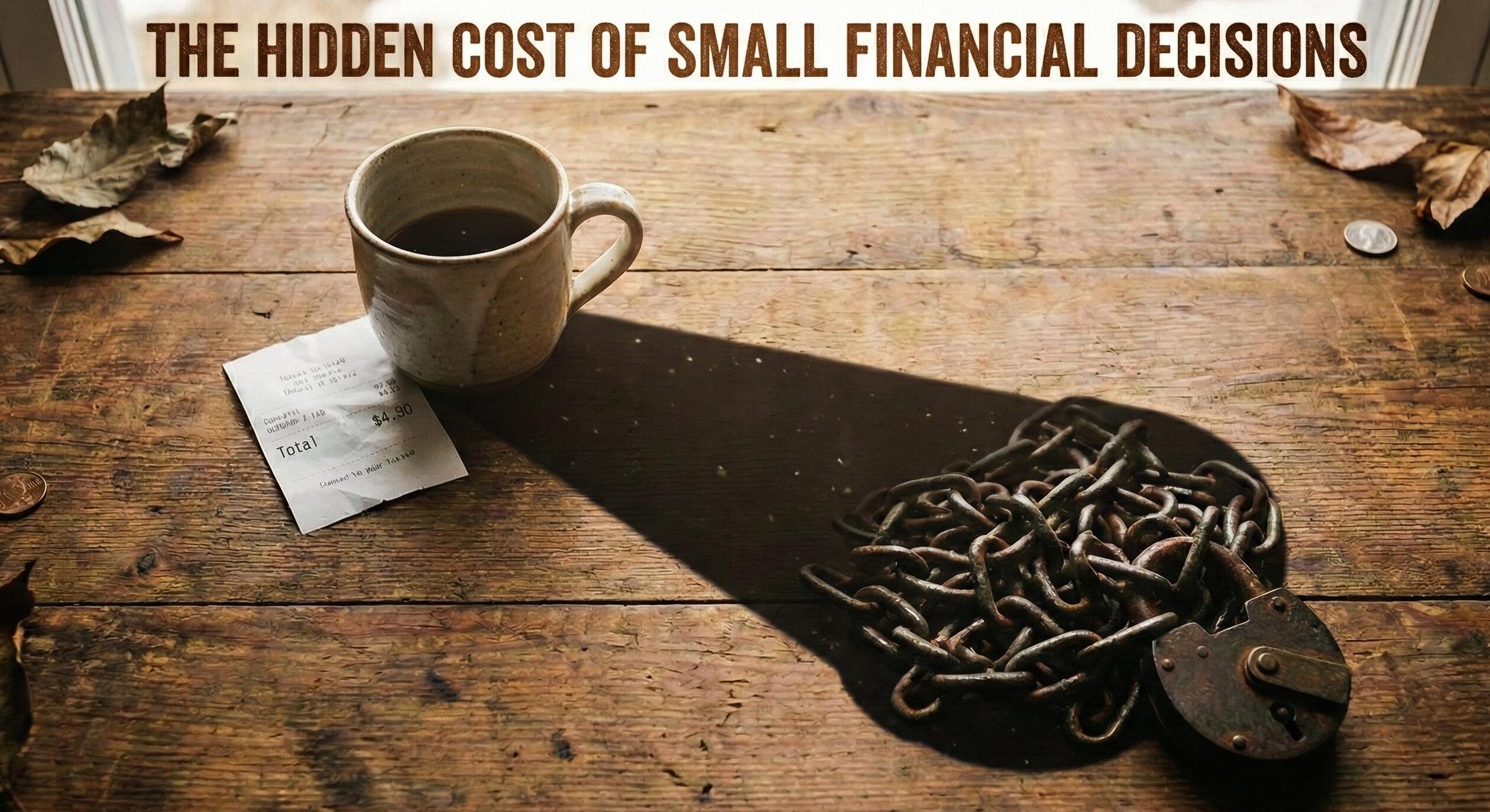
You grab coffee on the way to work. You order lunch instead of packing it. You click “buy now” on a book you’ll probably read someday. Each decision feels insignificant in the moment, barely worth a second thought. But here’s what most people never calculate: the hidden cost of small financial decisions isn’t just about the money you spend today—it’s about the future you’re trading away without realizing it.
Why We Don’t See Small Spending as Real Spending
Human brains aren’t wired for this kind of math. We’re excellent at recognizing immediate threats and opportunities, but terrible at connecting tiny actions today with consequences years from now. That’s not a personal failing—it’s just how our minds work.
When you spend five hundred rupees, your brain doesn’t register it the same way it would if you spent fifty thousand. The larger amount triggers caution, deliberation, maybe even stress. The smaller amount? It slips past your mental radar completely. It’s “just” five hundred rupees. Except it’s never just once.
Our financial systems make this worse, not better. Digital payments are frictionless. You tap your phone, enter a PIN, and the transaction is done. There’s no physical exchange, no counting of bills, no tangible sense of money leaving your hands. The psychological distance between wanting something and having it has collapsed to nearly zero.
This convenience is wonderful in many ways, but it has a side effect: it makes small purchases invisible. You can spend two thousand rupees across four transactions in a single day and barely remember any of them by evening. The hidden cost of small financial decisions grows in that gap between spending and awareness.
The Real Math Behind “Just This Once”
Let’s talk about what small really means. A two-hundred-rupee coffee doesn’t sound like much. If someone asked you whether two hundred rupees mattered to your financial future, you’d probably say no. And for one coffee, one time, you’d be right.
But that same coffee five days a week becomes four thousand rupees a month. Across a year, that’s forty-eight thousand rupees. Not on coffee as a category—on one specific habit, one automatic decision you make without thinking.
Now imagine that money didn’t disappear. Imagine it went into savings instead, earning even a modest return over twenty years. You’re not looking at forty-eight thousand anymore. You’re looking at somewhere between fifteen to twenty lakh rupees, depending on how that money grew. That’s the hidden cost nobody mentions when they say “treat yourself.”
This isn’t about coffee specifically. Replace it with any small recurring expense: streaming subscriptions you don’t use, food delivery three times a week, impulse purchases online, ATM fees from using out-of-network machines. Each one feels harmless. Collectively, they’re taking up space where your financial future could be.
The Subscription Trap Nobody Talks About
Subscriptions deserve their own conversation because they’re engineered to be invisible. You sign up once, usually with some promotional discount, and then the charge becomes automatic. It shows up on your statement every month, but you’ve stopped noticing it.
Here’s what makes subscriptions particularly insidious as a hidden cost of small financial decisions: they continue whether you use the service or not. That streaming platform you haven’t opened in three months? Still charging you. The premium app features you tried once and forgot about? Still there on your credit card statement.
Companies know this. They’re counting on it, actually. The business model depends on a percentage of subscribers who pay but don’t actively use the service. It’s not fraud—you did agree to it—but it’s also not a fair fight. Your attention is finite, and they’re betting you won’t remember to cancel.
Most people have at least two or three subscriptions they could cancel right now without noticing any change in their life. Sometimes more. A gym membership you meant to use but never do. A magazine subscription that auto-renewed. A premium tier of something when the free version would work fine.
Each subscription might only be two hundred, five hundred, or eight hundred rupees a month. But add up three or four of them, and you’re talking about real money—money that leaves your account automatically, month after month, funding services you don’t value enough to actively use.
When Convenience Costs More Than You Think
Convenience has a price tag. That’s not inherently bad, but it becomes a problem when we don’t realize we’re paying it or when the price doesn’t match the value we’re getting.
Food delivery is the clearest example. The meal itself might cost three hundred rupees. Then there’s a delivery fee, a platform fee, surge pricing if it’s raining or late at night, packaging charges, and often a tip. By the time the food arrives, you’ve paid five hundred or five hundred and fifty rupees for something that would have cost three hundred if you’d picked it up yourself, or two hundred if you’d made it at home.
Again, this isn’t about never using delivery. It’s about recognizing the actual cost. If you’re using it once a week as a genuine convenience because you had a long day and need a break, that’s a conscious choice. If you’re using it four or five times a week because you didn’t plan ahead or couldn’t be bothered to cook, that’s different. That’s the hidden cost of small financial decisions showing up disguised as convenience.
The same pattern appears everywhere. Taxis instead of public transport when the time savings are minimal. Express shipping for items you don’t need urgently. Buying lunch every day instead of packing it even twice a week. Grabbing snacks at premium convenience stores instead of planning ahead.
None of these choices make you irresponsible. They make you human. But being human in a system designed to make spending effortless means you need to build in your own friction—your own moments of pause—or the costs will stay hidden until they’re too big to ignore.
The Opportunity Cost You Never Calculate
Here’s the part most people miss entirely: the hidden cost of small financial decisions isn’t just what you spent. It’s what you didn’t do with that money instead.
Economists call this opportunity cost. Every rupee you spend on one thing is a rupee you can’t spend on something else. That’s obvious when you’re choosing between a laptop and a vacation—both are big enough that you naturally weigh the options. But when the choice is between a small purchase and nothing visible, the opportunity cost becomes invisible too.
Let’s make it concrete. Suppose you spend three thousand rupees a month on things that don’t really matter to you—random purchases, unused subscriptions, convenience fees that don’t add meaningful value. That’s thirty-six thousand a year.
What could that thirty-six thousand do instead? It could become an emergency fund that covers you when your laptop dies. It could be invested and start growing. It could fund a skill-building course that increases your earning potential. It could go toward something you actually care about, like a trip you’ve been wanting to take or upgrading something in your home that would genuinely improve your daily life.
The tragedy isn’t that you spent the money. It’s that you spent it without choosing. You didn’t actively decide that those small, forgettable purchases were more valuable than the alternatives. They just happened, and the alternatives never even entered your mind.
The Psychology of “Treating Yourself”
There’s a phrase that shows up a lot in consumer culture: “treat yourself.” It sounds positive, even empowering. You work hard, you deserve nice things, you shouldn’t deprive yourself of small pleasures. All of that is true. But it’s also become a justification for spending that has nothing to do with actual enjoyment.
Real treating yourself means doing something that genuinely adds value to your life. It’s intentional. You thought about it, you wanted it, you enjoyed it. The hidden cost of small financial decisions creeps in when “treating yourself” becomes automatic—a reflex you deploy to justify purchases you don’t actually want that much.
You’ve had a stressful day, so you buy something online to feel better. Except you don’t feel better. You feel the same, just poorer. You’re bored, so you order food. But you’re not hungry for that specific food—you’re just looking for stimulation, and spending money is easy stimulation.
This isn’t about judging those impulses. Everyone has them. The question is whether the spending is serving you or just serving itself. If buying that thing genuinely makes you happy, if it adds something real to your day, that’s fine. If it’s just a habit you’ve fallen into because spending is easier than sitting with discomfort or boredom, that’s when the costs start to add up without the benefits.
A colleague of mine used to buy books constantly. She loved the idea of reading them, loved the feeling of having them. But she wasn’t actually reading most of them. They piled up on her shelf, still wrapped, while she felt vaguely guilty every time she saw them. It took her a while to realize she wasn’t buying books—she was buying the feeling of being someone who reads, which isn’t the same thing. Once she saw that pattern, she didn’t stop buying books entirely. She just started asking herself whether she’d actually read each one. Most of the time, the answer was no, and she saved the money. The books she did buy, she read and loved.
How Small Decisions Become Big Patterns
The hidden cost of small financial decisions isn’t usually about individual purchases. It’s about patterns—behaviors that repeat so often they become part of your baseline spending without you noticing.
You don’t decide each morning whether to buy coffee. You just buy coffee because that’s what you do. You don’t evaluate whether you need food delivery tonight. You order it because it’s Wednesday and you’re tired and you always order on Wednesdays.
These patterns form because our brains love automation. It’s efficient. Making every decision from scratch would be exhausting. So we develop habits, and those habits run in the background while our conscious attention is elsewhere.
The problem is that financial habits can outlive their usefulness. Maybe you started buying coffee every morning when you had a job with a long commute and no time to make it at home. Now you work remotely, you have a coffee maker in your kitchen, but the habit continues because it’s a habit. The original reason is gone, but the spending remains.
Or maybe you signed up for multiple streaming services during a period when you had more free time and watched a lot of shows. Now you’re busier, you barely watch anything, but all the subscriptions are still active because canceling them requires action and keeping them requires nothing.
This is where the hidden costs accumulate fastest—not in the big, considered purchases, but in the autopilot ones. The things you spend money on not because you chose them today, but because you chose them once and never reconsidered.
What Awareness Actually Looks Like
Solving this doesn’t require becoming obsessive about every rupee. It requires something simpler but harder: paying attention.
Awareness means knowing what you’re spending money on, not approximately but actually. It means occasionally looking at your bank statement and asking yourself which of these expenses you’d make again if you had to choose right now.
For most people, that review reveals a pattern. There are purchases you’re glad you made—they added value, they solved a problem, they brought genuine enjoyment. Then there are purchases you barely remember making. Those are the hidden costs. Not the coffee you savored on a slow morning, but the coffee you grabbed out of habit and drank while staring at your phone without tasting it.
Awareness also means questioning your defaults. If your default is to order food when you’re tired, what would happen if your default was to make something simple instead, and ordering food became the occasional exception? If your default is to buy things when you’re bored, what would happen if your default was to pause and ask whether you’ll still want this tomorrow?
These aren’t restrictions. They’re just speed bumps—small moments of friction that create space for actual choice instead of autopilot spending.
The Difference Between Cheap and Meaningful
Here’s something that gets lost in conversations about money: the goal isn’t to spend as little as possible. The goal is to spend on things that matter and stop spending on things that don’t.
Some of your small purchases are absolutely worth it. That morning coffee with a friend where you actually talk and connect? Worth it. The book you’ve been excited about and will definitely read? Worth it. The meal you order because you’re genuinely too exhausted to cook and need the break? Worth it.
The hidden cost of small financial decisions only becomes a problem when the spending is mindless. When you’re not getting value back. When the money disappears and you can’t point to anything in your life that’s better because of it.
This means different things for different people. Someone who loves trying new restaurants might happily spend a lot on food and nothing on clothes. Someone else might buy expensive coffee without guilt because it’s their one daily pleasure, but never touch food delivery. Neither is wrong. What matters is that the spending aligns with what you actually value, not what you spend money on by default.
Building Better Defaults Without Deprivation
The most sustainable changes aren’t about willpower. They’re about design. You can’t rely on yourself to make the right choice every single time when you’re tired, stressed, or distracted. What you can do is set up your environment so the easier choice is also the better choice.
If you’re spending too much on food delivery, the solution isn’t to swear it off forever. It’s to make cooking easier. Prep ingredients on the weekend. Keep simple meals on hand. Make ordering out a genuine decision rather than a default.
If subscriptions are bleeding money, set a calendar reminder every three months to review them. It takes ten minutes. Cancel what you’re not using. Keep what you value. Let the friction be in continuing, not in canceling.
If impulse purchases are the issue, add a waiting period. When you want to buy something, put it in your cart but wait twenty-four hours. If you still want it tomorrow, buy it. If you forgot about it, you just saved money on something you didn’t actually want.
These aren’t rules. They’re systems. They work with your psychology instead of against it, reducing the hidden cost of small financial decisions without requiring you to become a different person.
When Small Changes Compound
The reverse of hidden costs is hidden benefits. Just as small expenses compound into large amounts over time, small savings and redirected spending compound into opportunities.
Saving an extra two thousand rupees a month won’t change your life immediately. But over five years, that’s more than a lakh of rupees, even without any returns. With modest investment returns, it could be significantly more. That’s a safety net, a career transition fund, a down payment on something meaningful.
The math works in your favor when you flip it. Every automatic expense you cut is money that can go somewhere else—somewhere you chose, somewhere that builds instead of just disappearing.
This isn’t about deprivation or sacrifice. It’s about paying attention to the hidden cost of small financial decisions so you can redirect that money toward things that actually matter to you. Not to someone else, not to some arbitrary standard, but to you and what you’re building.
Moving Forward With Clarity
Understanding the hidden cost of small financial decisions doesn’t mean you’ll never make another impulse purchase or that every rupee will be optimized. That’s not the goal, and it wouldn’t be sustainable even if it were.
The goal is simply to see what you’re doing. To recognize patterns. To notice when spending happens on autopilot and ask whether that autopilot is still serving you. Small financial decisions stay small when they’re intentional. They become hidden costs when they’re invisible.
You don’t need perfect control. You just need enough awareness to make sure your money is going where you actually want it to go, not just where it’s easiest for it to go. That shift—from unconscious to conscious, from autopilot to choice—is what transforms small decisions from hidden costs into intentional actions.
Start where you are. Look at what you spent money on this week. Not to judge it, just to see it. Notice what added value and what didn’t. Keep what matters, question what doesn’t, and trust that small adjustments made consistently will carry you further than you expect.FOLLOW FOR MORE…